

Dapeng Town Industrial Park, Tongshan District, Xuzhou City, Jiangsu Province, China
In contemporary architecture, steel structures are widely employed for their high strength, rapid construction, and design flexibility, appearing in everything from large industrial plants and logistics warehouses to commercial complexes and sports stadiums. However, a core issue concerning life and property safety must not be overlooked: the fire safety of steel structures.
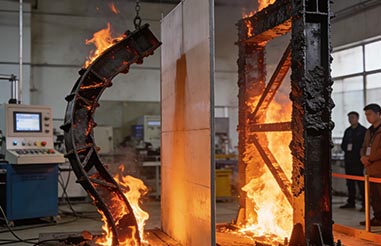
Steel is a non-combustible material, but this does not imply it is fire-resistant. Its mechanical properties (such as strength and stiffness) are highly sensitive to temperature variations.
Strength degradation: At 350°C, the yield strength of ordinary structural steel begins to decline significantly. By 500°C, its strength drops to approximately 50% of its room-temperature value. At 600°C, the steel has largely lost its load-bearing capacity, becoming as malleable as ‘noodles’.
Structural collapse risk: In unprotected fire scenarios, rapidly escalating temperatures cause steel structural members (beams, columns) to soften and distort, ultimately precipitating catastrophic collapse of the entire building structure within a short timeframe.
Therefore, the fundamental purpose of scientifically protecting steel structures against fire is not to prevent the steel from burning, but rather to employ a series of technical measures to slow the rate of temperature increase within the components during a fire. This establishes a fire resistance rating (e.g., 1 hour, 2 hours, 3 hours), thereby securing precious golden time for personnel evacuation and firefighting operations.
I.Mainstream Fire Protection Measures for Steel Structures
Currently, mature and widely adopted fire protection measures for steel structures fall into three primary categories:
This represents the most common and flexible protective method. Fire-retardant coatings are applied directly to steel components via spraying or brushing, forming a protective layer.
Intumescent Fireproof Coatings:
Principle: At elevated temperatures, the coating rapidly expands by tens or even hundreds of times, forming a dense, uniform char layer that acts as a thermal barrier, effectively preventing heat transfer to the steel substrate.
Characteristics: Features a relatively thin coating with good decorative properties. Commonly used for exposed steel structures with a fire resistance rating of up to 2 hours, such as beams and columns in sports stadiums, airport terminals, and commercial buildings.
Non-Expanding Fireproof Coatings (Thick-Film):
Principle: The coating itself possesses excellent thermal insulation properties, slowing heat transfer through its low thermal conductivity. Its fire resistance primarily depends on coating thickness.
Characteristics: Thick and robust coating, capable of achieving fire resistance ratings exceeding 3 hours. Primarily used for load-bearing components requiring high fire resistance (e.g., support columns in industrial buildings) or concealed structures.
Advantages: Relatively low cost and good durability.
Achieves physical isolation by completely wrapping steel components with non-combustible or flame-retardant materials.
Fireproof Board Envelopment:
Materials: Prefabricated fireproof boards such as gypsum boards, vermiculite boards, or calcium silicate boards.
Construction: Fixing the boards around the steel structure using adhesives, screws, or a stud framework system.
Advantages: Dry process, rapid installation, smooth finish, facilitates future maintenance and inspection. Widely employed in commercial buildings, hangars, and other spaces requiring aesthetic interior presentation.
Flexible Felt-like Material Cladding:
Materials: Inorganic fibre felts such as rock wool or glass wool.
Applications: Particularly suited to complex or irregularly shaped steel members, providing close-fitting coverage.
Advantages: Combines fire resistance with thermal insulation.
Cast-in-place concrete/mortar cladding:
Method: Formwork is erected around steel members, followed by pouring concrete or spraying fire-resistant mortar.
Advantages: High-strength protective layer, exceptional durability, and strong impact resistance.
Disadvantages: Significant self-weight and extended construction duration.
Principle: Filling the hollow sections (e.g., box columns) of steel members with water. During a fire, heated water circulates within the system, dissipating the heat absorbed by the members and effectively controlling the steel structure’s temperature.
Application: This is a highly effective active fire protection technique, though the system is complex and costly, typically employed in specialised, critical landmark buildings.
Beyond supplementary protective layers, fire resistance can be enhanced through design itself:
Section Optimisation: Increasing member cross-sectional dimensions slows steel temperature rise, naturally extending fire resistance duration.
Thermal Energy Diversion: Installing additional thermal diversion members along critical load-transfer paths protects primary load-bearing structures.
Our Professional Service Process:
Assessment: Determining the fire resistance requirements for each component based on architectural drawings, fire safety regulations, and functional usage.
Design: Tailoring optimal fire protection system designs to your specifications, integrating architectural aesthetics, budgetary constraints, and construction conditions.
Installation and Supervision: Providing professional installation teams or rigorously overseeing third-party contractors to ensure the quality and reliability of fire protection works.
Acceptance and Maintenance Guidance: Assisting with fire safety inspections and providing long-term maintenance recommendations.
Fire protection for steel structures constitutes a rigorous systems engineering endeavour, serving as the ‘invisible guardian’ of a building’s safety integrity. As a specialist provider of steel structure building solutions, we possess profound expertise in the characteristics and application scenarios of every technology. We pledge to deliver the most scientifically sound, cost-effective, and dependable fire protection solutions for each of your projects, jointly erecting a robust safety barrier.