

Dapeng Town Industrial Park, Tongshan District, Xuzhou City, Jiangsu Province, China
I.Specification Requirements
When steel column bases are supported by steel base plates, the following provisions shall be complied with:
The area of the steel base plate shall be calculated based on the compressive strength of the concrete, the load borne by the column base plate, and the tightening tension of the anchor bolts.
So what is the tightening tension of the anchor bolts?
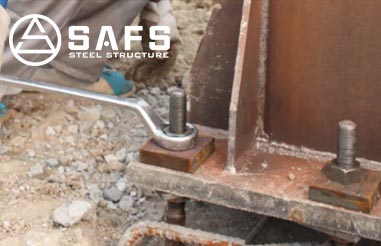
Anchor bolts
Anchor bolt specifications, positioning, and tightening must comply with design requirements. Protective measures shall be provided for the threads of anchor bolts.
Are there specific tightening requirements for anchor bolts in the design specifications? Generally, no specific tightening force requirements are mentioned.
1. Grouting beneath column base plates shall be performed using pressure grouting. This process may only commence after the structure has passed alignment, levelness, and verticality inspections, is adequately supported, and is securely and accurately connected to permanent structural members. The space beneath the foundation slab must be cleared of debris and thoroughly cleaned prior to grouting. Commercial grout shall be prepared, mixed, and applied according to the manufacturer’s instructions. Testing shall be conducted when necessary.
2. To prevent nut loosening, use double nuts, spring washers, or other effective measures to secure the nuts.
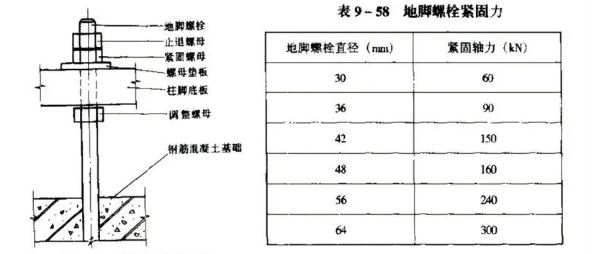 The data in the table provides a simple comparison with the preload force of high-strength bolts. For an M30 diameter, Grade 8.8 high-strength bolt, the tightening axial force is 310 kN (preload force). Thus, the requirements for anchor bolts are equivalent to 20% of those for high-strength bolts.
II. Relationship Between Tightening Force and Torque Value
The tightening forces listed in the table above are most commonly verified using torque wrenches during actual inspections. This involves converting axial tightening force to torque values:
Final construction torque is calculated using the formula: Torque coefficient × Preload × Bolt diameter.
The torque coefficient for high-strength bolt connection sets is determined through testing. But what about anchor bolts? If not tested, what value should be used? For example, if an empirical value of 0.2 is adopted, then the torque value corresponding to 60 kN for an M30 anchor bolt would be: 360 N·m.
III.Is it necessary to specify tightening torque?
Is it necessary to specify tightening torque for foundation anchor bolts? Generally, this requires case-by-case consideration. For example: mechanical foundation connections subjected to vibration or cyclic loads, as well as connections requiring fatigue resistance or high seismic performance. In these scenarios, higher preload requirements are essential, and prestressed anchor bolts may sometimes be necessary to meet specifications.
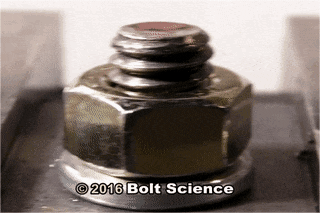
However, for standard anchor bolts, the table above provides only an approximate value. This can be understood as establishing a benchmark to facilitate quality acceptance by all parties. In reality, when controlling based on torque values, the actual amount of torque that ultimately translates into the bolt’s preload varies significantly without testing. Only about 20% of the applied torque may be effectively utilized, while the remaining 80% is dissipated by friction at the contact surfaces.
Even when anchor bolts are pre-tensioned, significant loss of preload may occur due to concrete creep and shrinkage. Therefore, for standard anchor bolts, it is advisable to neither over-tighten nor under-tighten them, with 50% of the bolt’s design tensile strength serving as a standard guideline.
Considering the above, for ordinary anchor bolts, ensuring secondary grouting is fully compacted and implementing measures to prevent nut loosening may become even more critical.
This is precisely how engineers think. Although the relevant content in various standards and specifications may sometimes appear fragmented, they still strive to establish a systematic closed-loop in specific project designs, aiming to consider every detail as thoroughly as possible.