Dapeng Town Industrial Park, Tongshan District, Xuzhou City, Jiangsu Province, China
In steel structures, space frames and trusses are two common structural forms, exhibiting significant differences in structural configuration, load-bearing characteristics, and design requirements. Understanding their design principles and fundamental distinctions is crucial for engineering design and construction.
I.Design Principles
A truss is a structure composed of members connected at both ends by hinges, primarily bearing axial tension or compression forces. It typically consists of triangular units. When designing trusses, the following points should be considered:
Structural Form: Trusses are typically planar structures, commonly appearing as triangles, trapezoids, etc., suitable for bridges, stages, advertising frames, and similar applications.
Member Connections: Truss member connections are relatively fixed, usually employing welded joints, with nodes typically being pinned or rigidly connected.
Material Selection: Truss structures utilize relatively less steel, resulting in lightweight construction suitable for medium-span buildings.
Construction and Installation: Truss construction is relatively straightforward, but attention must be paid to node stability and connection quality.
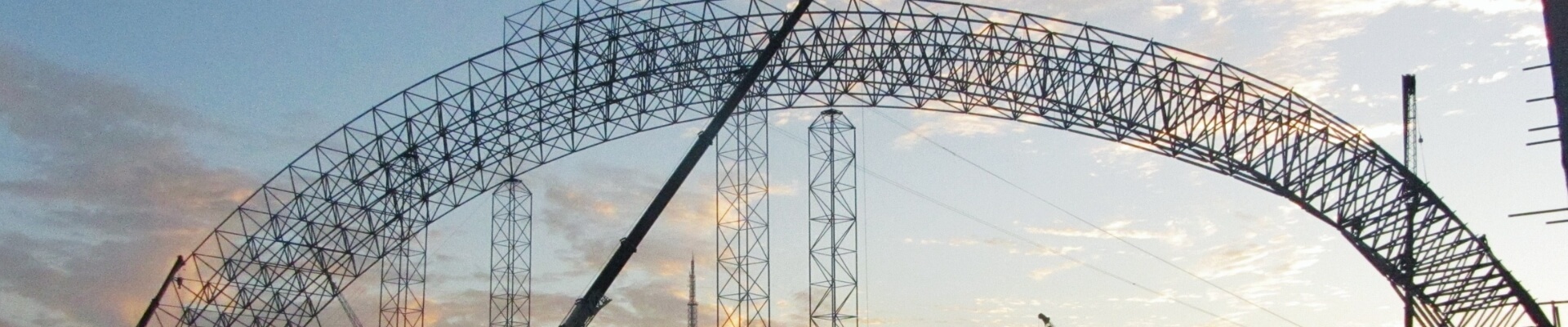
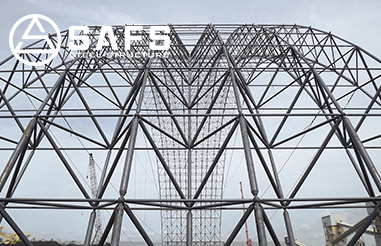
A space frame is a spatial structure formed by connecting multiple members in a grid pattern through nodes. Basic units include triangular pyramids, triangular prisms, cubes, etc. When designing space frames, the following points should be noted:
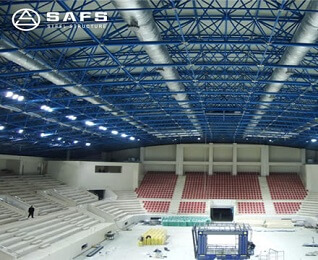
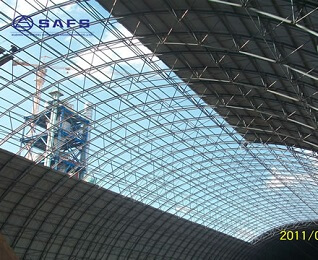
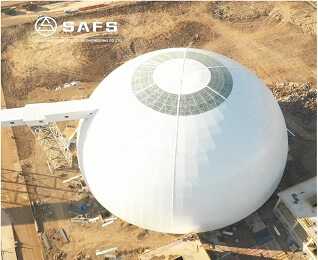
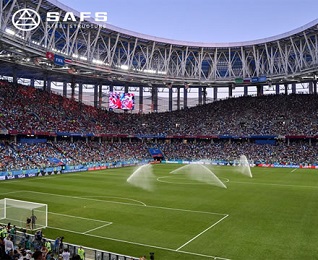
Structural Form: As a spatial structure with isotropy, space frames are suitable for large-span buildings like stadiums and airport terminals.
Member Connections: Space frame member connections offer flexibility, employing methods such as bolted or welded joints.
Material Selection: Space frame structures utilize relatively more steel but provide high spatial stiffness and load-bearing capacity, making them suitable for large-span buildings.
Construction and Installation: Truss structure construction is relatively complex, requiring attention to node precision and stability.
II.Fundamental Differences
The fundamental difference between trusses and space frames lies in their structural form. Trusses are planar structures primarily composed of triangular units, suitable for planar or curved structures; space frames are spatial structures formed by multiple members connected in a grid pattern, suitable for spatial curved surfaces.
Träusses primarily bear axial tension or compression forces. Their simple structure suits medium-span structures. Space frames, however, feature spatial load distribution, high rigidity, and superior seismic performance, making them ideal for large-span structures.
Träuss design is relatively straightforward with convenient construction, suitable for linear structures with clearly defined load directions. Space frame design is complex with higher construction difficulty, suited for intricate three-dimensional spatial structures.
III. Conclusion
Both space frames and trusses possess distinct advantages in steel structures. Selection should be based on comprehensive evaluation of project requirements, span, load capacity, and economic factors. Understanding their design principles and fundamental differences enhances the quality and efficiency of engineering design and construction.