
Dapeng Town Industrial Park, Tongshan District, Xuzhou City, Jiangsu Province, China
To achieve column-free spaces with exceptionally large spans (typically exceeding 60 metres, with maximum spans exceeding 300 metres), the steel structure design for exhibition centres must comprehensively consider span requirements, architectural form, economic viability, construction feasibility, and flexibility for subsequent use. The following outlines the preferred steel structure systems and key technical solutions for exhibition centres:
I.Selection of Mainstream Long-Span Steel Structures
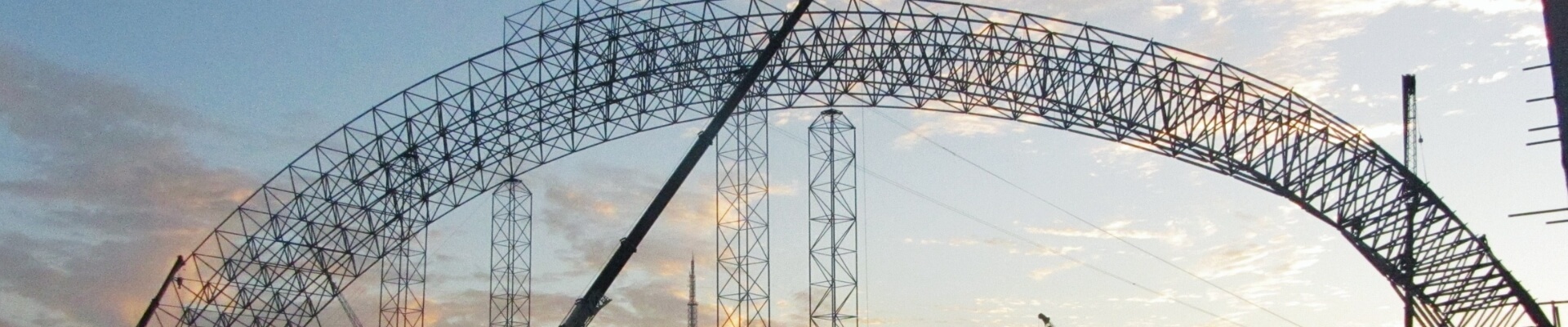
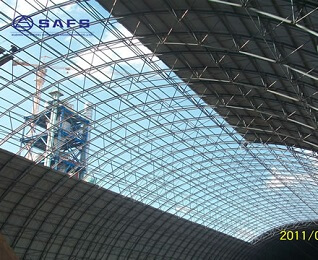
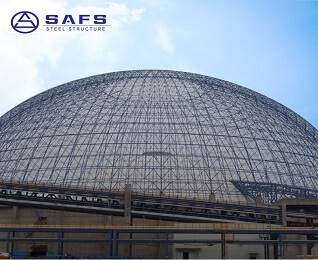
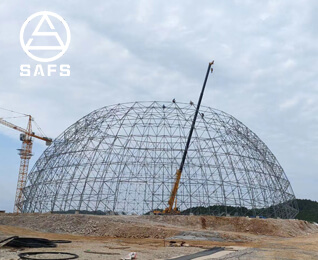
Types: Double-layer flat grid, triple-layer grid, grid shell (single/double layer), open-web grid structure
Advantages:
Mechanical efficiency: Members subjected solely to axial forces, material utilisation rate >90%, steel consumption approx. 60–100 kg/m² (for 100-metre spans).
High Spatial Rigidity: Distributed load-transfer system rapidly disperses localised loads, delivering superior deformation resistance.
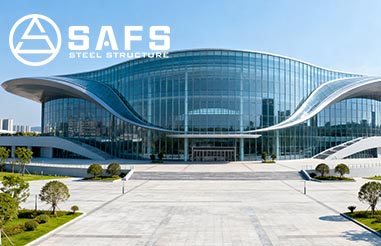
Design Adaptability: Capable of forming free-form surfaces (e.g., undulating, spherical) to meet contemporary exhibition centre aesthetics.
Types: Tensioned beams, tensioned trusses, cable-supported domes
Core Principle: Rigid members (beams/trusses) + flexible cables + struts, resisting deflection through prestressed cables.
Advantages:
Extreme span capability: Effortlessly achieves 150–300m spans (e.g., cable-supported domes).
Lightweight economy: Steel consumption as low as 30–50kg/m² (40% steel savings compared to pure steel structures).
Visual Transparency: Minimises internal supports, enhancing spatial openness.
Types: Tubular Truss Arch, Box-Section Arch
Suitable Applications: Long rectangular exhibition halls (arch arrangement along the shorter dimension).
Advantages:
Optimised Load-Bearing: Primarily axial compression forces, ideal for large spans.
Mature Construction Methods: Can be segmentally hoisted or lifted as a single unit.
II.Summary of Design Considerations
For spans exceeding 100 metres, cable-stayed structures or cable-supported domes are preferred; for spans between 60 and 100 metres, space frames/shells are optimal.
Form-driven design: Curved surfaces must be synergistically optimised with structural forces (e.g., through inverted suspension form-finding).
Life-cycle cost considerations: Account for maintenance complexity (e.g., membrane structure cleaning) and energy benefits (photovoltaic payback period approximately 8 years).
The final solution must integrate architectural vision, local climate, construction resources, and budgetary constraints. Contemporary exhibition centres have evolved from purely functional spaces into vehicles for technical aesthetics, with steel structure design serving as the core engine for achieving this objective.