

Dapeng Town Industrial Park, Tongshan District, Xuzhou City, Jiangsu Province, China
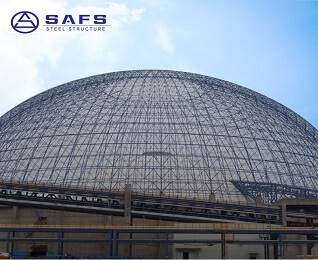
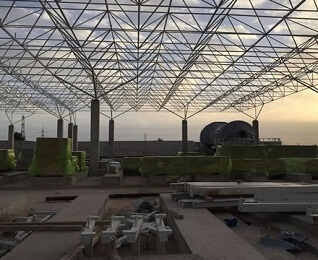
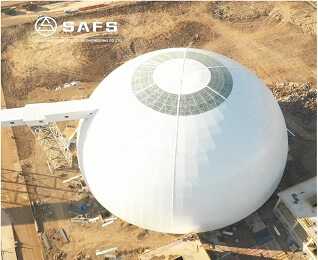
Space frame structures are widely used in large-scale stadiums, exhibition halls, industrial plants, and other buildings. As these structures age, load requirements increase, or defects such as localized corrosion or buckling emerge, the load-bearing capacity of members and overall structural stiffness often necessitate reinforcement. This paper systematically reviews commonly used reinforcement methods, key construction considerations, and the latest technological advancements in the industry, helping designers and construction personnel quickly identify suitable reinforcement solutions.
Reinforcement Needs Analysis
After defining reinforcement objectives, structural analysis (finite element or manual calculation) must be conducted to evaluate stress distribution and select the most economical and constructable reinforcement method.
Common Reinforcement Techniques
| Reinforcement Method | Main Principle | Applicable Scenarios | Typical implementation methods |
| Cross-Section Enlargement Method | By adding steel plates, angle bars, channel bars, and other components to increase the cross-sectional area of structural members, their bending and compressive strength is enhanced. | Members exhibiting corrosion, localized weakening, or increased loading. | Welded or bolted steel plates and structural steel |
| Prestressed reinforcement | Introducing prestressed cables or struts redistributes structural forces, thereby reducing member stresses. | The large-span space frame exhibits excessive deflection and requires enhanced overall stiffness. | Cable and Prestressed Strand Layout |
| (CFRP) Reinforcement | Apply high-strength carbon fiber cloth/sheets to the surface of structural members to form a composite load-bearing layer, enhancing tensile strength, shear resistance, and fatigue resistance. | Applications requiring lightweight reinforcement in confined spaces; Localized reinforcement of structural nodes. |
Apply carbon fiber cloth, carbon fiber clamps, or carbon fiber strips |
| Steel Plate Bonding Reinforcement | Apply steel plates to members or nodes, utilizing structural adhesive to achieve stress transfer. | Situations requiring rapid construction and avoiding high-temperature welding. | High-performance structural adhesive steel plates. |
| Establish a support system | Add horizontal, vertical, or diagonal bracing to enhance overall stability and rigidity. | The original structure exhibits insufficient stiffness, resulting in noticeable vibration or localized displacement. | Horizontal braces, diagonal braces, vertical braces. |
| Node stiffening plate/Bolt reinforcement | Weld or bolt stiffeners and ribs at the joints to distribute stresses and enhance joint stiffness. | Critical areas where stress is concentrated and cracks are prone to form. | Reinforcement plates, bolted in place. |
Conclusions and Recommendations
1. Solution Selection: Prioritize the combination of section enlargement + prestressing while ensuring structural safety. If construction space is limited or weight is strictly constrained, opt for lightweight solutions like carbon fiber bonding or sleeve + carbon fiber.
2. Construction Safety: For high-altitude work, maximize the use of spot fixing, pre-assembly, or bonding techniques to minimize welding risks.
3. Quality Control: Conduct rigorous non-destructive testing and on-site load verification before and after reinforcement to ensure outcomes meet design specifications.
4. Post-Construction Maintenance: Establish a long-term monitoring plan for reinforced sections, particularly focusing on prestress tension and carbon fiber bond integrity, to promptly identify and address potential degradation.
Through systematic needs analysis, technology selection, and quality control, the reinforcement of space frame steel bars can achieve the goals of safety, economy, and durability, providing reliable assurance for the long-term use of large-scale spatial structures.