Dapeng Town Industrial Park, Tongshan District, Xuzhou City, Jiangsu Province, China
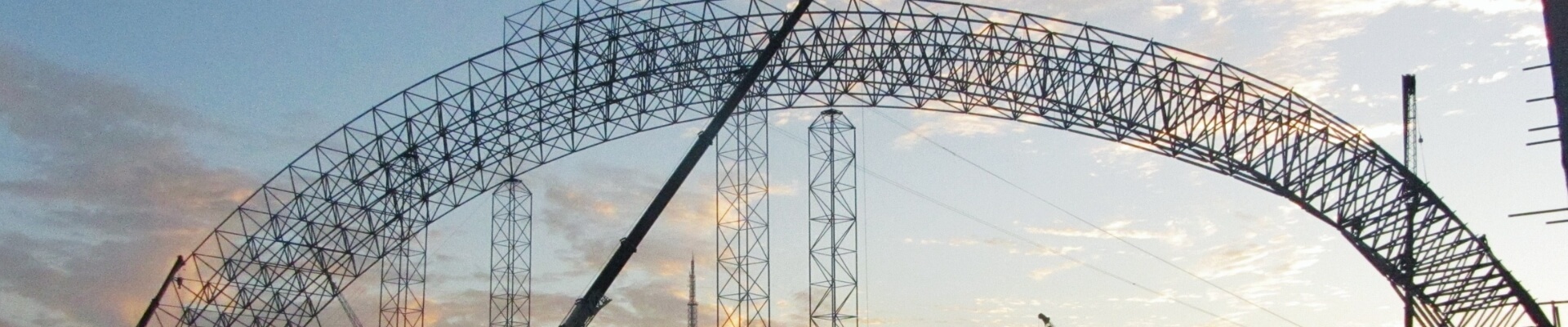
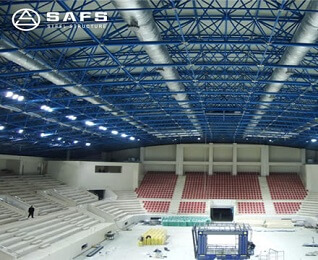
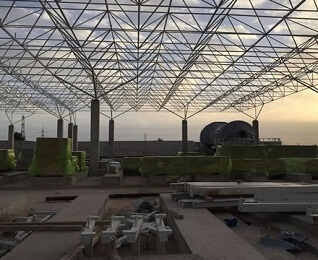
grid structures are a type of highly statically indeterminate spatial truss structure. Due to their excellent load-bearing performance (in theory, truss members are only subjected to axial forces), high stiffness, excellent overall integrity and seismic performance, strong load-bearing capacity, minimal influence from uneven settlement of supports, and high adaptability. With the continuous improvement of computational theories and the rapid development of computer technology, analysis and design of any extremely complex three-dimensional structures have become feasible. Therefore, grid structures are widely applied in industrial and civil building fields. However, if the supporting structure, bearing type, and boundary conditions of a space truss structure are designed improperly, it can significantly impact the safety and economy of the structure.
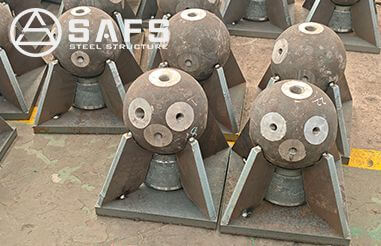
The bearing nodes of a space truss structure must ensure safe and reliable transmission of bearing reactions, and therefore must possess sufficient strength and stiffness. Under vertical loads, support nodes are generally subjected to compression. However, in some inclined truss structures, local support nodes may be subjected to tensile forces, and in some cases, they may also be subjected to horizontal forces. Therefore, the design of support nodes should adapt to their specific load characteristics. Additionally, the design of support nodes should align with computational assumptions and fully reflect the design intent. Since grid structures are highly statically indeterminate truss systems, the constraint conditions of support nodes significantly influence the node displacements and member internal forces of the space frame; differences in constraint conditions between construction and design will directly alter member internal forces and support reactions, and may even cause changes in the sign of member internal forces. Therefore, sufficient attention should be given to the design of support nodes in grid structures. Whether the design of a space frame structure is safe and economical, the most critical factor lies in whether the selected support structure, support type, and boundary conditions are reasonable. Therefore, in specific designs, we should avoid analyzing and designing the upper space frame structure and the lower support system separately, especially when the displacement of the space frame supports relative to the lower structure is difficult to simulate using elastic constraint methods. In such cases, the support structure and the upper space frame should be modeled and analyzed as an integrated system to ensure that the calculated results better align with reality.