
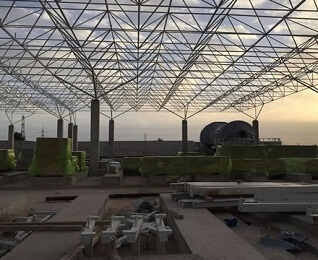

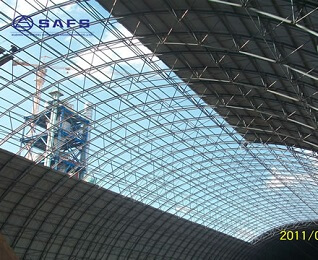
Dapeng Town Industrial Park, Tongshan District, Xuzhou City, Jiangsu Province, China
(1) Roof load: When the roof load is large, the grid needs to be higher to provide sufficient rigidity and stability. On the contrary, if the roof load is small, the grid height can be relatively low.
(2) Span: The span of the grid is another important factor in determining its height. The larger the span, the larger the grid height usually needs to be in order to meet the requirements of rigidity and stability.
(3) Plane shape and support conditions: The plane shape (such as circular, square, rectangular, etc.) and support conditions (such as peripheral support, point support, etc.) of the grid will also affect the determination of its height. For example, the height of the grid with a circular or square plane can be smaller, while the height of the grid with a narrow plane needs to be larger due to the obvious unidirectional force transmission. The height of the grid with peripheral support is usually smaller than that of the grid with point support.
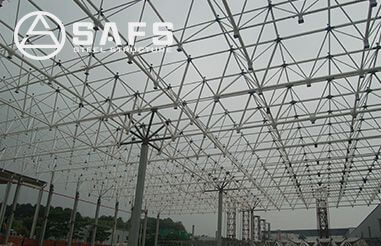
(1) Empirical formula: In actual projects, engineers usually estimate the height of the grid based on empirical formulas. For example, the height of the grid can be 1/15 to 1/20 of the span, or between 1.2 and 2.2 meters depending on the specific situation. However, these empirical formulas are for reference only, and the specific height needs to be adjusted according to other factors.
(2) Computer software calculation: In order to obtain more accurate results, engineers usually use professional computer software to calculate the height of the grid. These software can comprehensively consider multiple factors such as the span, load, plane shape, and support conditions of the grid to obtain the most reasonable grid height.
(3) Design in cooperation with the grid manufacturer: When determining the height of the grid, it is also a wise choice to cooperate with a professional grid manufacturer. They have professional designers and design software, and can customize the design according to the specific needs and actual conditions of the customer, so as to ensure that the height of the grid meets the use requirements and is economical and reasonable.
(1) Meet the requirements for passing pipes: If the grid needs to pass pipes, the height of the grid must also meet the space requirements of these pipes.
(2) Consider the node structure: Different node structures also have a certain impact on the height of the grid. For example, when bolted ball nodes are used, the grid height can be relatively large; when welded hollow ball nodes are used, the grid height can be relatively small.
(3) Meeting the functional requirements of the building: Finally, the determination of the grid height also needs to consider the functional requirements of the building. For example, equipment or personnel passages may need to be arranged under the grid, and these factors need to be considered when determining the grid height.
In summary, the determination of the grid height is a complex and critical process that requires comprehensive consideration of multiple factors and the use of scientific methods for calculation and determination.