

Dapeng Town Industrial Park, Tongshan District, Xuzhou City, Jiangsu Province, China
Imagine trekking long distances in a new pair of shoes. What makes you feel most comfortable? It’s not the shoe’s flashy appearance, nor the durable material of its sole—it’s the seemingly unassuming insole. Quietly bearing your entire body weight, it cushions every step’s impact and adjusts to your foot’s shape for a perfect fit. Without it, even the finest shoes would make every stride a struggle.
The transition plates in steel structure bearings serve precisely as these “insoles.”
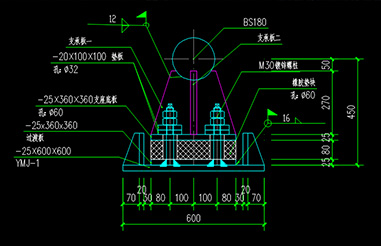
Beneath the majestic space frame roof of the stadium, this seemingly unassuming steel plate component, though ordinary in appearance, shoulders a triple mission:
Just as insoles can compensate for slightly oversized shoes, transition plates effortlessly resolve unavoidable deviations in embedded part positioning during construction through their carefully designed elliptical holes (with apertures exceeding the anchor bolt diameter by at least 10 millimeters).
When hundreds of tons of steel structure weight are concentrated and transferred to the concrete foundation, the transition slab acts like an insole dispersing pressure on the sole. Through proper thickness design (pressure bearings should not be less than 12 millimeters) and localized bearing capacity verification, it ensures uniform load transfer and prevents the risk of concrete surface crushing.
Temperature fluctuations cause steel structures to expand when heated and contract when cooled. The rubber pads or sliding mechanisms installed between transition plates and bearing base plates function much like the elastic layer in shoe insoles, enabling slight rotational and horizontal displacement within the bearings. This effectively releases thermal stresses, preventing cracks from forming in the structure due to accumulated strain.
Primary applications:
Pressure-bearing nodes: Particularly suitable for spatial grid structures such as space frames.
Long-span structures: When bearing reaction forces are substantial or spans are extensive.
Temperature-sensitive structures: Applications requiring accommodation of thermal deformation or horizontal displacement.
Key Design Principles:
Clear load transfer path: Ensures effective transmission of loads from the superstructure to the foundation via transition plates.
Rational and flexible construction: Hole positioning must allow sufficient adjustment allowance.
Strength-stiffness matching: Thickness selection must satisfy local bearing and bending requirements.
Though small in size, transition plates embody the ingenuity of steel structure connections through their design principles and functional roles. They serve not only as “adjusters” for construction tolerances but also as “optimizers” for force flow transmission. While ensuring structural safety, they significantly enhance construction convenience and cost-effectiveness.