

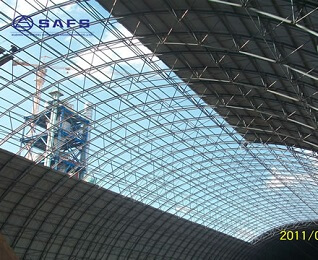


Dapeng Town Industrial Park, Tongshan District, Xuzhou City, Jiangsu Province, China
In the design, procurement, and construction of steel structure projects, accurately interpreting steel grades is crucial for ensuring material compliance and project safety. As the world’s two largest steel production and application markets, China and the United States have developed distinct grading systems.
While the steel grading systems of both countries share connections, they also exhibit significant differences. A thorough understanding of these systems is essential for industry professionals.
China-U.S. Steel Grade Comparison Table
| Steel Grade Designations | Corresponding Standard Number | Performance Parameters |
| Q235 | GB/T 700 | 235 |
| Q345 | GB/T 1591 | 345 |
| Q336 | NB/7201 | 235 |
| Q36 | A572 Gr.55 | 255 |
| A36 | A572 Gr.50 | 250 |
| A35 | A36A572 Gr.35 | 250 |
| A32 | ASTM A336 | 230 |
| A338 | ASTM A572 | 350 |
| A336 | ASTM A572 | 345 |
I.Core Differences in Chinese and American Brand Names
China’s naming conventions comprehensively consider yield strength, carbon content, alloying elements, and other factors. By combining letters, numbers, and element symbols, they precisely convey steel properties for easy memorization and understanding. In contrast, the U.S. primarily uses numerical sequences to denote steel grades and compositions. While concise, this approach poses greater challenges for non-specialists in interpreting information.
China employs meticulous methods for indicating alloy elements, specifying distinct labeling approaches based on varying content ranges. While the U.S. also indicates alloy element content, its notation for certain trace elements differs from China’s approach.
Due to varying industry standards and construction practices, China and the U.S. exhibit distinct preferences for specific steel grades in certain applications. For example, in structural steel construction, China commonly uses low-alloy high-strength structural steels like Q345; the U.S. may select corresponding steels based on ASTM standards.
The primary reason for these differences lies in the distinct industrialization processes and standardization journeys of the two countries. China’s standards have evolved by integrating its unique resource characteristics and industrial demands, undergoing continuous refinement. In contrast, U.S. standards were established earlier and hold significant international influence, with their system largely grounded in the nation’s industrial framework and market requirements.
In the context of globalization, professionals in the steel structure industry must proficiently master both the Chinese and American steel grade systems. This expertise is essential for accurate material selection in international collaborations and project undertakings, thereby ensuring engineering quality!