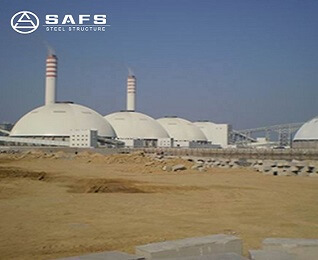
Dapeng Town Industrial Park, Tongshan District, Xuzhou City, Jiangsu Province, China
Laoshan Velodrome, a cycling venue for the 2008 Beijing Olympic Games, is located west of the General Administration of Sport’s Cycling and Fencing Management Center in Shijingshan District, Beijing. It is China’s first all-weather indoor velodrome with a wooden track.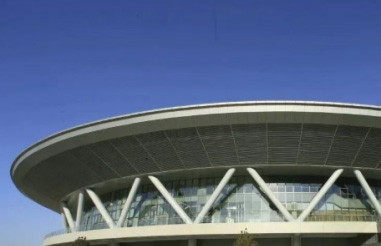
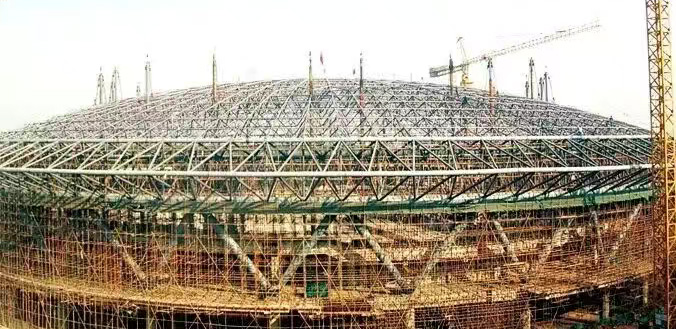
The main arena is a flying saucer-shaped circular building with one partial underground floor and three above-ground floors. The eaves height is 18.8m, with the roof’s highest point reaching 34.3m. The roof covers a diameter of 148.536m. The main structure adopts a reinforced concrete frame-shear wall structure, while the roof utilizes a double-layer spherical latticed shell structure.
The central track is elliptical with a circumference of 250 meters. Both the track surface and supporting trusses are entirely processed from Siberian pine to meet requirements for hardness, slip resistance, deformation resistance, and corrosion resistance.
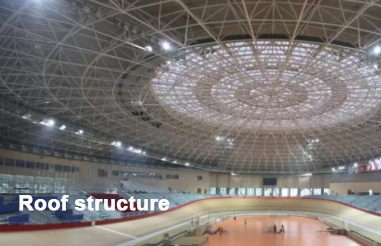
A 56m diameter lighting area is installed in the central part of the roof, using polycarbonate sheets (double-layer) with excellent light transmission and diffusion properties. Among this area, 240m² is operable for ventilation and smoke exhaust.
The roof structure of Laoshan Velodrome adopts a double-layer spherical latticed shell based on the architectural form, covering a diameter of 149.536m with a rise of 14.69m (rise-span ratio of approximately 1/10) and a surface area of about 18,240m².
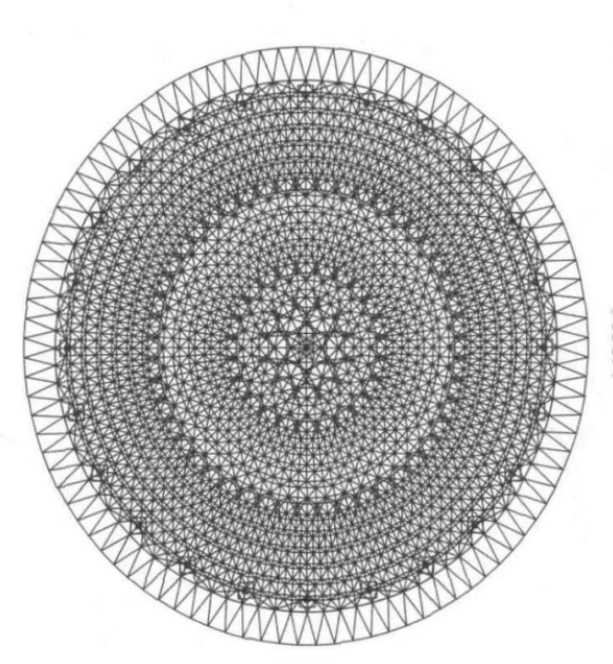
The latticed shell is supported by a ring truss resting on 10.35m-high herringbone-shaped steel columns. The column bases connect to the lower concrete structure through cast steel spherical hinge bearings. The herringbone steel columns are arranged continuously in a ring, with slightly inward-inclined bases. The diameter at the column tops is 133.06m, while at the bases it is 126.40m. The ring truss consists of four ring beams connected by web members. The latticed shell has a thickness of 2.8m and a span of 133.06m, giving a thickness-span ratio of 1/47.5.
The grid form of the latticed shell adopts a rib-ring quadrilateral pyramid configuration. Each grid unit forms a trapezoidal quadrilateral pyramid, radiating outward from the center. As grid sizes increase, division points are uniformly inserted at appropriate positions, filling triangular grids to maintain approximately equal member lengths and achieve uniform spatial force distribution. There are 32 radial grids, with 96 circumferential grids in the outermost ring. The latticed shell members use circular steel tube sections with diameters of 114-203mm, and joints utilize welded hollow spherical joints with diameters of 300-600mm.
The four ring beams of the column-top circumferential truss use circular steel tube sections. The three ring beams around the upper and lower chords of the latticed shell have sections of φ500-600X16, while the column-top ring beam has a diameter of φ1200X20. There are 24 pairs of herringbone columns, each with a section of φ1000X18mm.
The total steel consumption for the steel structure is 1,860t, equivalent to 102kg/m², of which the herringbone steel columns and ring beams account for approximately 40kg/m².
The velodrome’s roofing system serves as the largest external envelope and interior interface in the competition hall, critically affecting rain protection, sound insulation, thermal insulation, building acoustics, and indoor lighting. The construction approach is as follows:
Aluminum-magnesium-manganese standing seam metal roofing panels (fan-shaped, thickness ≥0.9mm);
100mm thick aluminum foil fiberglass insulation layer (density: 12kg/m³);
Aluminum-zinc coated pressure steel plate backing, 0.47mm thick, with 10mm thick waterproof gypsum board or 9mm thick glass fiber reinforced cement board (density 100kg/m³) laid on top, surface with aluminum foil, joints sealed with 200mm wide general gypsum board strips;
Galvanized Z (C) section purlins;
100mm thick 48kg/m³ superfine centrifugal glass fiber sound-absorbing layer, wrapped with glass fiber cloth;
0.47mm thick colored galvanized steel plate, 20% perforation rate, hole diameter 2-3mm.
Another highlight of this project is the support system for the latticed shell roof: continuously arranged herringbone columns in a circular distribution with hinged bases. This support scheme not only provides excellent lateral resistance but also greatly simplifies column base design (the horizontal thrust generated by the latticed shell under vertical loads is balanced by the column-top ring truss; the steel columns bear only axial pressure, allowing hinged column bases). It also effectively addresses temperature effects on the large-span roof during service.
The “spherical hinge bearing + ring-shaped herringbone columns” constitutes a typical “breathing” structure. During temperature changes, the ultra-large steel roof only causes radial displacement at column tops without generating temperature stress—ingeniously solving the prominent temperature stress problem in large-scale steel roof structures during service.
The economic efficiency of the double-layer spherical latticed shell is also well demonstrated in this project. Despite such a large span, the steel consumption is only 72kg/m² (excluding herringbone columns and column-top circumferential trusses).