
Dapeng Town Industrial Park, Tongshan District, Xuzhou City, Jiangsu Province, China
With their short construction timelines, spacious layouts, and high cost-effectiveness, steel structure warehouses have become the mainstream choice for industrial and logistics infrastructure across Africa. Recent months have seen a surge in steel warehouse projects across the continent—from South Africa’s large-scale logistics centers and Tanzania’s 5,967-square-meter fully prefabricated warehouses to Mozambique’s 135×50m large-span industrial facilities and Zambia’s 40×30m steel structures. Africa’s steel consumption is projected to grow by 4.7% to 5.5%, driven by large-scale construction and mining-related expansion.
However, a recurring pattern has emerged: many contractors prioritize main-frame assembly speed while overlooking hidden works, connection workmanship, and local climate adaptation. This leads to settlement, roof leakage, structural loosening, and coating failure shortly after commissioning—dramatically shortening building lifespan and driving up maintenance costs. Drawing on extensive overseas project experience, SAFS Steel Structure has identified the most frequent construction mistakes and developed standardized processes to eliminate them.
Improper foundation embedment and anchor bolt installation is the most hidden yet critical defect. Many sites neglect anchor bolt positioning accuracy, failing to provide adequate support during concrete pouring—resulting in bolt to shift and excessive verticality deviation. Some teams, in the name of convenience, use flame-cutting to enlarge holes to compensate for misalignment. This practice, while appearing to solve the installation problem, actually compromises the column base load-bearing system, leading to uneven stress distribution, leaning columns, and eventual settlement—creating long-term structural safety hazards that fail to meet any international acceptance standard.
How to avoid: Anchor bolts must be precisely positioned with proper templates and supports before concrete placement. Any field modification of anchor bolts requires approval from the project’s structural engineer of record. Never use flame-cutting to enlarge bolt holes.
Poor-quality component installation and bolt tightening frequently cause connection failures. Common issues include insufficient temporary bolts, missing or under-torqued permanent bolts, inconsistent thread exposure, and mixed use of bolts and washers of different specifications. Connection gaps are often left unfilled before fixing. Under long-term wind loading and equipment vibration, bolts gradually loosen and joint forces become unbalanced—triggering component displacement, connection failure, and threatening overall structural stability.
How to avoid: Follow torque specifications with graded tightening procedures. Maintain proper thread exposure length. Never mix bolt grades on the same connection. Use torque wrenches and document bolt torque reports.
The cladding system—roof and wall panels, flashings, and window/door joints—is the frontline defense against water ingress. Yet most sites cut corners on sealing: uneven sealant application, insufficient lap widths, and missing waterproof underlayments. Africa’s concentrated rainy seasons and intense downpours expose these flaws quickly. Within months, roof leakage and wall dampness appear—not only corroding steel components but also damaging stored goods, drastically reducing the warehouse’s value and service life.
How to avoid: Invest in proper sealing materials and workmanship. Ensure adequate roof slope for rapid water discharge, install high-capacity gutter systems, and detail all roof penetrations (vents, exhaust fans, skylights) with mechanically fastened and sealed flashings.
Many construction teams apply standard anti-corrosion systems without adapting to Africa’s extreme UV radiation, high temperature and humidity, or coastal salt spray. Common failures include insufficient surface preparation (sandblasting grade), inadequate coating thickness, and missed application at corners and edges. Simultaneously, they neglect purlin adjustments, roof slope calibration, and other details—resulting in panel deformation, water pooling, dust accumulation, and premature coating failure.
How to avoid: Tailor anti-corrosion systems to site-specific conditions. For humid and coastal regions, hot-dip galvanized steel structures provide far better durability than ordinary painted steel. Roofing sheets with higher zinc or aluminum-zinc coatings last considerably longer under tropical conditions. Ensure proper surface preparation (shot blasting) and apply multiple layers of heavy-duty anti-corrosion primer.
SAFS Steel Structure has established a full-process standardized quality control system to eliminate these common construction defects. Our approach includes:
Precise foundation embedment with strict anchor bolt positioning and grouting protocols
Standardized bolt tightening and connection workmanship with torque documentation
Meticulous cladding waterproofing with proper sealing, flashing, and drainage design
Climate-adapted anti-corrosion solutions tailored to each project’s environmental conditions
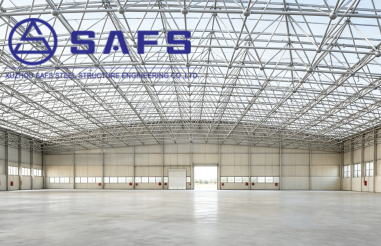
By adhering to international construction acceptance standards and rejecting rushed, low-quality approaches, SAFS delivers steel structure warehouses that are stable, low-maintenance, and built to last—eliminating the quality issues that plague the industry.
Contact Xuzhou SAFS Steel Structure Engineering Co., Ltd. (SAFS)
Specializing in steel structure engineering, pipe truss engineering, space frame engineering, welded ball space frames, trestle engineering, and related fields.