

Dapeng Town Industrial Park, Tongshan District, Xuzhou City, Jiangsu Province, China
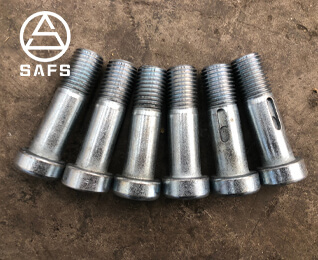
High-strength bolts used in space frame engineering are categorised into distinct grades, which directly determine their mechanical properties and suitable applications.
Bolts of M12 to M36 specifications: Typically employ grade 10.9S. Here, ‘10’ denotes a nominal tensile strength of 1000 MPa, ‘9’ denotes a yield-to-tensile strength ratio of 0.9, while ‘S’ signifies suitability for steel structures.
Bolts of M39 and above: For these larger diameter bolts, the 9.8S grade is typically employed. This signifies a nominal tensile strength of 900 MPa and a yield-to-tensile strength ratio of 0.8.
The grade requirements for bolts of different specifications can be quickly ascertained via the table below:
| Bolt specifications | Performance Grade | Nominal tensile strength | Ratio |
|
M12~M36 |
10.9S |
1000 MPa |
0.9 |
|
M39~M64 |
9.8S | 900
MPa |
0.8 |
|
M90~M120 |
9.8S | 900
MPa |
0.8 |
The production and utilisation of high-strength bolts necessitate compliance with a series of stringent technical requirements to ensure the safety and reliability of space frame structures.
Material Selection: Grade 10.9S bolts are typically manufactured from alloy steels such as 20MnTiB (boron steel); whereas Grade 8.8S bolts may utilise steels such as 45 or 35. These materials must undergo appropriate heat treatment (e.g., quenching and tempering) to achieve the requisite strength properties.
Mechanical Properties: Bolts must undergo tensile load testing, with values conforming to standard specifications (e.g., M30 bolts require a tensile load ≥582 kN). For bolts ranging from M39 to M64×4, hardness testing (32–37 HRC) may substitute tensile load testing. Should any dispute arise regarding hardness test results, the tensile load test on the actual bolt shall serve as the arbitration method.
Threads and Dimensions: Bolt threads must comply with standard tolerance requirements to ensure proper engagement with the threaded holes in the bolt-ball joints. Dimensions shall conform to the provisions of GB/T 16939 ‘High-Strength Bolts for Steel Space Frame Bolt-Ball Joints’.
Surface Treatment and Defects: Bolt surfaces shall generally undergo oxidation treatment or other rust-preventive treatments. Concurrently, bolts shall not exhibit surface defects such as dents or scratches that impair functionality.
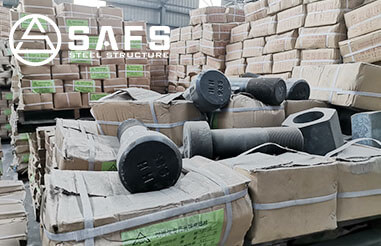
In space frame engineering, high-strength bolts ranging from M12 to M36 most commonly employ the 10.9S grade, whilst large-diameter bolts of M39 and above predominantly utilise the 9.8S grade. These bolts are specifically engineered for space frame structures and must satisfy stringent requirements concerning material composition, mechanical properties, and manufacturing processes.