Dapeng Town Industrial Park, Tongshan District, Xuzhou City, Jiangsu Province, China
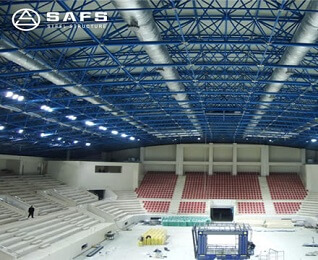
In tropical and subtropical regions such as the Middle East Gulf area and coastal cities in Southeast Asia, steel structures are increasingly becoming the mainstream structural form for airport terminals, sports venues, logistics centers, and industrial parks. However, in high-temperature and high-humidity environments, steel grid structures face durability challenges due to corrosion, joint failures, and moisture accumulation.
In high-temperature, high-humidity environments, the durability of steel structures primarily faces the following issues:
Accelerated Corrosion
High humidity provides ideal conditions for corrosion, while high temperatures accelerate the corrosion reaction process. This hastens the reaction between iron elements in steel structures and oxygen/water, forming rust that reduces component strength.
Joint Failure
Moisture penetration and temperature fluctuations cause stress fatigue at joints (e.g., bolted connections), leading to loosening and fracture.
Moisture Accumulation
Trapped moisture within the structure intensifies corrosion and may trigger mold growth.
Anti-corrosion processes are critical for enhancing structural steel durability. Below are several effective solutions:
Hot-Dip Galvanizing
This process immerses steel structures in molten zinc to form a dense zinc layer that blocks moisture and oxygen. It provides sacrificial anode protection for the steel in localized damage and is suitable for high-temperature, high-humidity environments.
Epoxy Coating
As a high-performance coating, epoxy offers superior corrosion resistance and adhesion. Applying multiple layers before construction creates a robust protective barrier with excellent temperature and humidity tolerance.
Cathodic Protection
Cathodic protection introduces an external current, converting the steel surface into a cathode to inhibit corrosion. This method is ideal for ensuring long-term stable operation of large steel space frames in high-temperature, high-humidity environments.
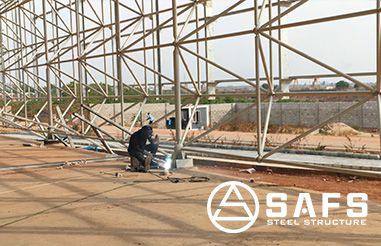
Node areas are the most susceptible to corrosion and aging in space frame structures. This vulnerability stems from their complex construction prone to water accumulation, coupled with internal cavities in many nodes. If left unsealed, moisture or salt ingress becomes extremely difficult to remove later.
Common Risks:
– Micro-gaps at ball node-member junctions;
– Unsealed bolt holes and access ports;
Sealants with poor aging resistance begin peeling after 3 years.
Recommended Strategies:
Apply epoxy potting or high-elasticity sealant to all joints after assembly;
Enclose internal spaces of spherical nodes to prevent moisture ingress causing “hidden corrosion”;
Use high-performance sealants with 10+ year service life, such as polyurethane or modified silicone;
Employ double-layer sealing washers for bolted connections to enhance moisture resistance.
Ventilation and moisture removal design is another critical measure to enhance the durability of steel grid structures. Incorporating trending keywords (e.g., “steel structure ventilation design,” “high-temperature high-humidity moisture removal”), the following are several effective ventilation and moisture removal solutions:
Natural Ventilation Design
In steel grid structure design, natural airflow can be introduced through vents, skylights, and other means to facilitate air circulation and reduce moisture accumulation.
Mechanical Ventilation Systems
In high-humidity environments, mechanical ventilation systems can be installed. Fans forcefully expel humid air while introducing dry air, thereby lowering humidity levels within the steel structure.
Moisture-Absorbing Material Application
Moisture-absorbing materials (such as silica gel desiccants) can be placed inside the steel structure to absorb moisture and reduce environmental humidity.
In high-temperature, high-humidity environments, the integrated structural durability design combining corrosion protection, sealing, and ventilation is a critical factor determining the lifecycle of steel structures. Space frame structures, characterized by dense nodes, large spans, and complex loading conditions, require long-term durability planning from the initial design stage.
For customized corrosion protection solution design specifications or project case studies, please leave a message for consultation. SAFS will provide you with one-on-one technical support.