
Dapeng Town Industrial Park, Tongshan District, Xuzhou City, Jiangsu Province, China
The logistical edge of structural steel lies in its high degree of factory prefabrication and modularity. All steel components are precision-engineered, welded, and anti-corrosion treated within a controlled factory environment, resulting in standardized units with optimized dimensions and weight. These units can be efficiently bundled and stacked to maximize container and heavy-haul truck space, enabling high-volume, low-loss transportation across long distances. Even for remote sites or regions with logistical constraints, the transportability of steel far exceeds that of traditional materials which require extensive on-site “wet work.”
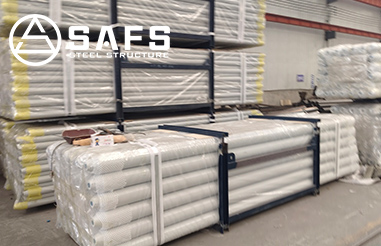
This logistical efficiency translates into significant global project advantages:
Accelerated Timelines & Weather Resilience: Component transportation and on-site foundation work can proceed concurrently, drastically compressing the construction cycle. Once delivered, steel structures transition into an efficient “plug-and-play” assembly phase, eliminating the need for casting and curing. This minimizes the impact of rain or extreme cold, ensuring project predictability.
Optimized Cost Control & Budget Precision: Standardized logistics lower overall shipping costs. More importantly, since 70%-80% of the fabrication is completed off-site, material and labor costs are “locked in” early. This significantly reduces unforeseen expenses caused by site complexities, labor fluctuations, or material waste, making the total budget more controllable.
Enhanced Engineering Quality & Site Safety: A factory-controlled environment ensures high-tolerance precision and uniform coating quality, improving the project’s integrity from the source. Furthermore, the shift from “construction” to “installation” reduces high-risk activities like high-altitude welding, creating a more orderly site and lowering the risk of safety incidents.
Simplified Management & Environmental Stewardship: On-site requirements are reduced as there is no need for large-scale processing areas or raw material stockpiles. This lowers management complexity and significantly reduces construction waste, noise, and dust pollution, aligning with modern green and civilized construction trends.
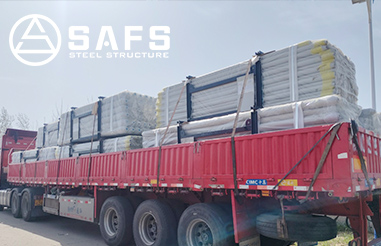
In conclusion, the logistical convenience of steel structures is not a standalone benefit; it is the vital link between efficient factory prefabrication and rapid site assembly. It directly drives optimization across schedule, cost, quality, and safety, providing EPC (Engineering, Procurement, and Construction) contractors with a powerful competitive edge and operational control.