Dapeng Town Industrial Park, Tongshan District, Xuzhou City, Jiangsu Province, China
The proper handling of steel structural members during transportation directly impacts on-site installation efficiency, project costs, and ultimately structural safety.Below are key considerations for steel structural members during transport, which I shall detail across four phases: pre-loading, loading, transit, and post-unloading.
| Stage | Core work | Key Considerations |
| Before loading | Preparations | Inspection and inventory, packaging and protection, rational planning of loading sequence |
| Loading in progress |
Loading |
Correct hoisting, proper padding, secure lashing, and prevention of deformation |
| In transit |
In Transit |
Route reconnaissance, steady driving, en route inspection |
| After unloading |
Unloading & Storage |
Civilised unloading, orderly stacking, prompt inspection |
This is the foundation for ensuring transport safety; as the saying goes, ‘Sharpening the axe doesn’t delay the woodcutting.’
Inventory and Acceptance:
Verify that the specifications, models, and quantities of the poles match the delivery note.
Inspect the poles themselves for any damage, paint peeling, or severe corrosion upon leaving the factory, and record findings accordingly.
Packaging and Protection:
Contact Point Protection:
At all contact points between poles and lashing ropes, between poles themselves, and between poles and vehicle platforms, use soft materials such as timber blocks, rubber pads, or burlap sheets to prevent paint abrasion and component impact damage.
Sharp Edge Protection: Wrap protruding elements such as bolt holes and connection plates to prevent scratching other poles or injuring lashing personnel.
Rain and Moisture Protection: For materials requiring long-distance transport or sensitive to humidity (e.g., fully painted poles), employ measures such as canvas covers to prevent rain or snow damage.
Loading Plan Design:
Optimal Loading: Plan loading sequence and positioning in advance based on pole dimensions, weight, shape, and vehicle capacity. Ensure even weight distribution without overloading or uneven loading.
‘Last In, First Out’ Principle: Load poles installed later (e.g., main components) first, followed by those installed earlier (e.g., secondary components). This enables sequential unloading on-site, minimising rehandling.
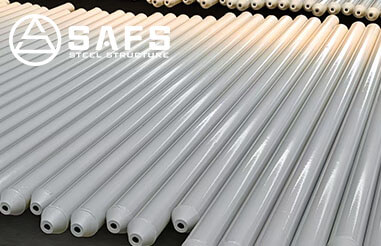
This is the crucial step in preventing deformation and damage to structural members.
Correct Lifting Procedures:
Specialised lifting equipment (such as steel spreader beams or soft slings) must be used. Direct contact between wire ropes and sharp edges of structural members is strictly prohibited to prevent damage to the members and paintwork.
Lifting points must be calculated or designated according to design specifications. Dragging or prying structural members is strictly forbidden to prevent plastic deformation.
Proper Padding:
Place timber blocks evenly across the vehicle platform. These blocks must possess sufficient strength and width to prevent direct contact between the pole and the vehicle deck.
For oversized components (>12m), timber blocks must be positioned at the lifting points and both ends to prevent deformation from jolting during transit.
Secure lashing:
Employ professional lashing equipment such as chain hoists, hand chain hoists, and wire ropes (with tensioners). The use of simple fibre ropes is prohibited.
Lashing points must be located at structurally robust sections (e.g., node plates), avoiding direct pressure application at weak points like the centre of members.
Securing must employ multiple points and multiple straps to ensure the pole and vehicle form a stable unit, preventing movement or rolling in any direction (forward/backward, left/right, up/down).
For tall or toppling-prone components, dedicated supports or a ‘trestle frame’ constructed from structural steel must be used for securing. Simply stacking is strictly prohibited.
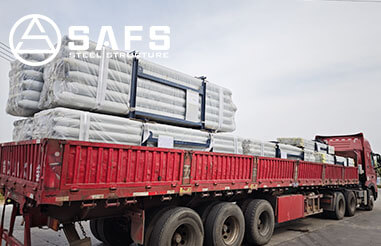
Route Reconnaissance: Plan the transport route in advance, ascertaining road widths, height restrictions, weight limits, bridge load capacities, and potential obstructions along the way to ensure safe passage for vehicles.
Steady Driving: Operators must maintain a constant speed, avoiding abrupt acceleration, sudden braking, and sharp turns to minimise impact forces on components.
En-Route Inspections: During extended journeys, conduct checks at intermediate stops to verify that lashing straps remain secure and components are properly aligned, tightening as necessary.
Civilised Unloading:
Protective lifting gear such as soft slings must also be used during unloading.
The signalman and crane operator must coordinate seamlessly, lifting and lowering gently to ensure poles land steadily and avoid violent impacts.
Standardised Stacking:
Level Ground: The stacking area must be firm, level, well-drained, and free of standing water.
Proper Elevation: Poles must be stacked on timber blocks or concrete pedestals, elevated at least 200mm above ground level to prevent moisture absorption and soil contamination.
Stable and Orderly:
Stacking should not exceed three layers. Each layer must be separated by timber spacers, which should be vertically aligned to prevent bending or deformation of the poles.
Classification and Labelling:
Poles of different specifications and batches must be stacked separately and clearly labelled with identification tags for easy retrieval and installation.
In summary, the core principles governing the transportation of steel structural members are: ‘Prevention first, thorough protection, and secure fastening.’ Neglect at any stage may result in damage to the members, thereby compromising installation accuracy, increasing the workload for rectification, and potentially jeopardising the safety of the entire structure. A meticulously planned transport scheme and its rigorous execution constitute vital safeguards for the successful completion of steel construction projects.