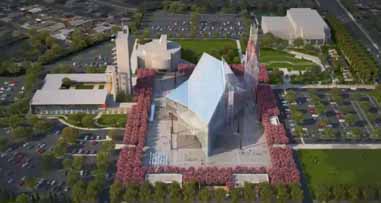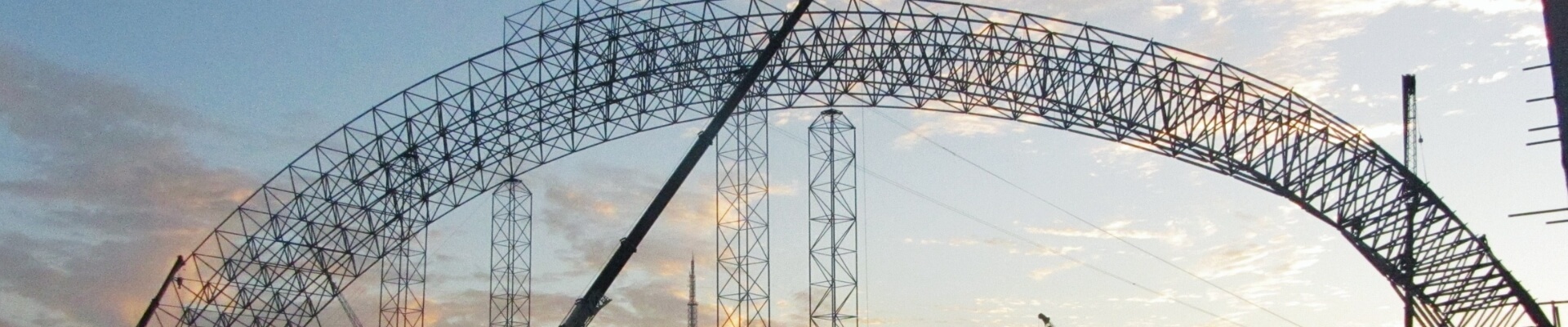


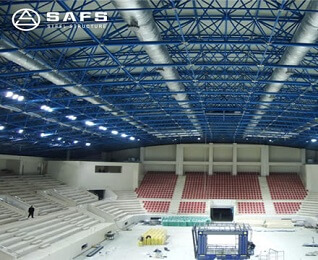
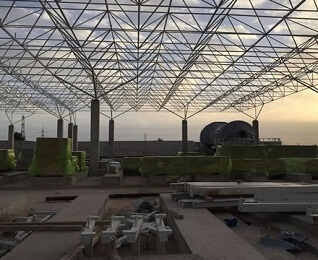
Dapeng Town Industrial Park, Tongshan District, Xuzhou City, Jiangsu Province, China
If the Bible is a love letter from God to humanity, then churches are like frozen love songs. Sacred and solemn, churches serve as the link between heaven and earth, the meeting place of the transient and the eternal. They embody a spiritual significance that transcends physical space. Not only do they manifest God’s glory, but they also carry the weight of history’s cultural legacy, narrating the enduring legend of faith.
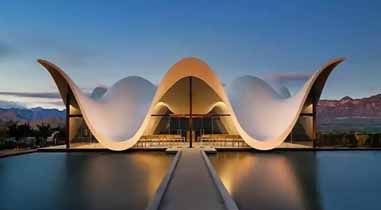
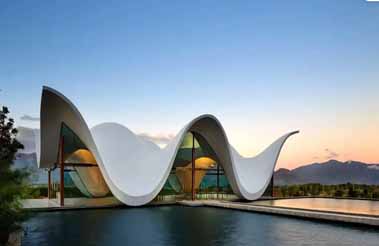
This captivatingly elegant chapel, nestled on the picturesque Bosjes Farm outside Cape Town, stands as a masterpiece of modern architecture—a harmonious symphony of design. Its silhouette echoes the surrounding mountains, while its undulating canopy harmonizes with the landscape. Pools and translucent glass surfaces create a sense of weightlessness, allowing the structure to seem to float effortlessly, seamlessly merging into the vistas of the green valley and distant peaks. Its gracefully undulating white wave-like exterior presents a perfectly symmetrical and balanced composition, along with a soothing, sinuous optical effect, as if the wings of God were floating in the valley.
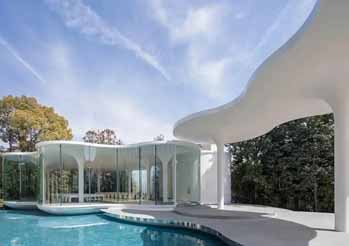
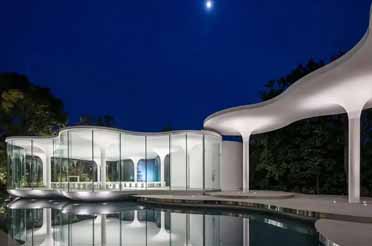
Japan’s newly constructed “Cloud of Luster” Chapel replaces the former “White Wing” Chapel as part of the La-Vienna Wedding Hall complex, serving as a sacred space to commemorate life’s most significant days. The chapel’s entirely transparent structure opens boundlessly toward the front garden, water features, and expansive greenery. Its gentle curves and translucent glass evoke the image of light clouds dwelling within nature, enveloping dreamlike light and shadow. The chapel’s white is pure and resplendent, radiant and luminous. Double-curved circular pillars descend from the minimalist ceiling, connecting vertically with the monochrome floor—evoking the appearance of natural white stalactites.
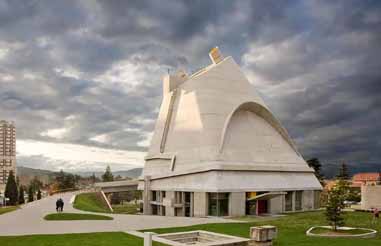
In the small southern French town of Fermey, stands a church that appears ordinary at first glance: the Saint-Pierre Church.
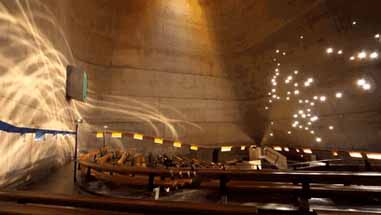
Yet step inside, and you’ll be utterly stunned by its hidden wonders. Dazzling flashes of light scatter across the walls like stars, creating an ethereal sensation of floating through a sea of celestial bodies.
This church stands as the final masterpiece of the “architectural visionary” Le Corbusier. It was the most protracted and tumultuous project of his career, yet ultimately the most exquisite—completed a full 41 years after his passing.

While its exterior appears impenetrably solid, the interior reveals a hidden wonderland. With each step, the scenery transforms, as scattered circular openings shimmer like nebulae. Above, three feet from your head, divine presence resides—alongside sun, moon, and starry skies.

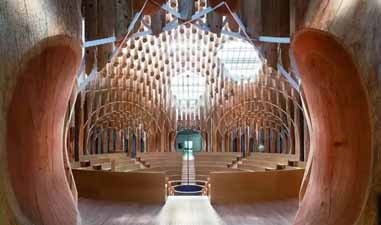
The Korean “Light of Life” Church is located south of Mount Polly in Gapyong, 30 kilometers from Seoul.
The project began in 2008 when a Christian entrepreneur donated a large quantity of Siberian red pine timber to the pastor free of charge, hoping to build a church that embodies faith.
The church architecture seamlessly integrates into the local landscape. The interior sanctuary reveals an astonishing “inner volume” distinctly different from the exterior, resembling “a personal microcosm.” Protestantism pursues simplicity in expression and opposes all forms of idol worship. Therefore, the church strictly adheres to doctrinal principles. While expressing Christian symbols, it seeks to evoke emotions in every visitor through ritual, philosophy, spirituality, and art.
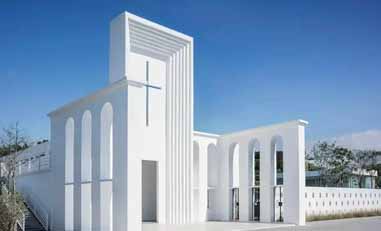
The “White Chapel” within an industrial complex in Guangzhou, Guangdong, breaks away from the rigid classical style of traditional churches while preserving the relics of ancient architecture. Through minimalist and refined design, it imbues religious architecture with a fresh spiritual essence. Vast expanses of undisturbed pure white liberate the senses from the clamor of time and environment, allowing one to purely perceive the order of space and the presence of light. Tranquil, luminous, and serene, it offers a dual purification for both the visual and the spiritual.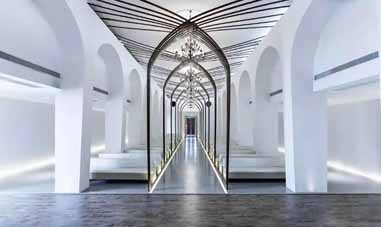
The interior employs a concise and supremely symmetrical spatial arrangement, distilling the orderly beauty of traditional churches. Guided by natural light, visitors progressively experience stillness, solemnity, and sanctity.
The arched ironwork installation indoors, with its fluid geometric curves, solid material texture, and deep iron hue, creates a striking contrast against the white space. The symmetrical orderly beauty evokes a sense of progressive tranquility.

The Church of Our Lady of Tears in Syracuse, Italy, surrounded by a botanical garden spanning nearly 17,000 square meters, stands as Sicily’s largest pilgrimage church. In 1953, a statue of the Virgin Mary miraculously shed tears. To commemorate this mystical event, the government launched an unprecedented design competition.
Ultimately, Michel Andrault and Pierre Parat from the École des Beaux-Arts in Paris emerged victorious with their sculpturally refined design.
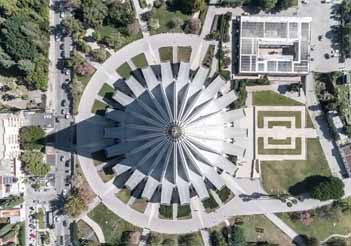
Due to archaeological discoveries beneath the site, construction of the Church of Our Lady of Tears took 28 years to complete. Eschewing ornate decoration, it reinterprets the towering form of centuries-old tradition through a modern lens.
Its pure and profound beauty stems purely from its unadorned structure. With its monumental distinctiveness, it became not only a Sicilian landmark but also a pioneer in religious architecture of its time.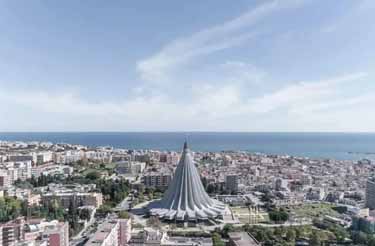
The spatial form of the surface evokes the shape of falling tears, reflecting the sacred event that led to the church’s construction. It carries deeper religious significance: symbolizing the elevation of humanity guided by God, and serving as a beacon guiding believers toward the divine.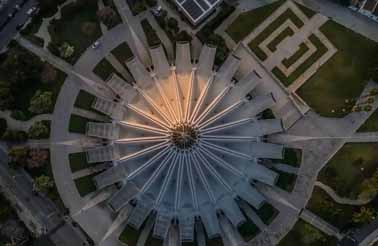
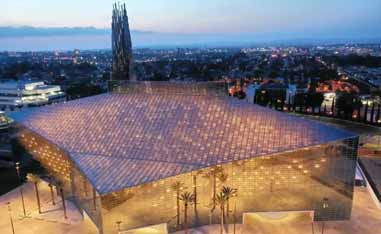
In the spring of 1968, Dr. Robert Schuller resolved to build a Crystal Cathedral in California, USA. He shared his vision with renowned architect Philip Johnson:
“I am not building an ordinary cathedral. I am creating an earthly Eden where anyone who enters feels as though they have stepped into paradise.”