Dapeng Town Industrial Park, Tongshan District, Xuzhou City, Jiangsu Province, China
In modern industrial and construction sectors, steel structures have become the preferred choice for numerous projects due to their high strength, lightweight nature, and rapid construction capabilities. However, the inherent properties of steel mean it is highly susceptible to corrosion in harsh environments such as damp, rainy conditions, high salt spray exposure, or chemical corrosion, thereby compromising structural safety and service life. As an enterprise dedicated to providing globally superior, safe, and robust steel structure designs and products while maintaining a steadfast commitment to environmental sustainability, we recognise that advanced anti-corrosion coating technologies are pivotal to ensuring the enduring durability of steel structures. Among these, hot-dip galvanising and heavy-duty anti-corrosion coatings represent two core technologies. Operating either independently or in synergy, they deliver exceptional protection for steel structures.
Hot-dip galvanising is a time-honoured and highly effective corrosion prevention process. Its principle involves immersing pre-treated steel components into molten zinc baths, forming a uniform, dense layer of zinc alloy and pure zinc upon the steel surface.
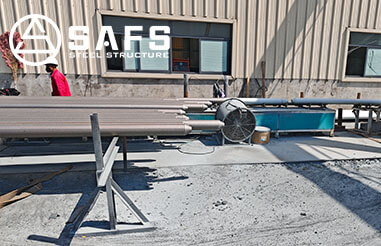
Operating Principle:
Physical Barrier Protection: The zinc layer acts as a robust physical barrier, isolating the steel substrate from external corrosive agents such as oxygen, water, and salt spray.
Sacrificial Anode Protection: Zinc possesses a lower electrochemical potential than steel. When the zinc coating is damaged, zinc corrodes preferentially, thereby ‘sacrificing’ itself to shield the steel substrate from rusting. This ‘electrochemical protection’ mechanism is pivotal to the enduring effectiveness of hot-dip galvanising.
Advantages:
Exceptional longevity: Under typical atmospheric conditions, hot-dip galvanising provides 20–50 years or more of maintenance-free corrosion protection, significantly reducing lifecycle costs.
Comprehensive coverage: Molten zinc penetrates every nook and cranny of steel components—including internal surfaces, welds, and edges—forming a uniformly dense protective layer with no blind spots.
Abrasion Resistance: The zinc-iron alloy layer forms a metallurgical bond with the steel substrate, exhibiting strong adhesion and excellent resistance to mechanical damage.
Environmentally Friendly: Zinc is a recyclable metal, and the hot-dip galvanising process itself has minimal environmental impact, aligning with sustainable development principles.
Heavy-duty anti-corrosion coatings refer to coating systems capable of providing long-term protection in severe corrosive environments. Typically comprising multiple layers, each coating layer fulfils specific functions to collectively construct a robust anti-corrosion barrier.
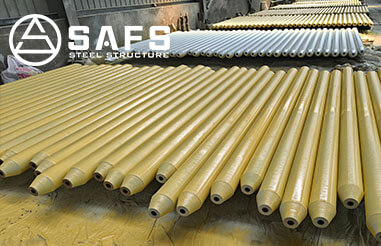
Typical System Composition:
Primer: Typically an epoxy zinc-rich primer. Containing a high proportion of zinc powder, it provides sacrificial anodic protection and forms excellent adhesion to the steel substrate, serving as the foundation of the entire coating system.
Intermediate Coat: Commonly an epoxy micaceous iron oxide intermediate. It offers excellent shielding and impermeability, effectively blocking the penetration of corrosive media while increasing coating thickness.
Topcoat: Typically polyurethane or fluorocarbon topcoats are employed. The topcoat not only provides the final physical barrier but also offers outstanding weather resistance, UV resistance, colour retention, and gloss retention. It can be supplied in various colours to meet architectural aesthetic requirements.
Advantages:
Customised Protection: Different coating types can be selected based on specific corrosion environments (e.g., acids, alkalis, solvents, high temperatures) to achieve precise protection.
Aesthetic Appeal: The diverse range of topcoat colours meets architectural design requirements.
Repairability: Localised coating damage can be repaired on-site, facilitating maintenance.
High Adaptability: Can be factory-applied or applied on-site, demonstrating strong adaptability to component dimensions and shapes.
Environmental Trends: Technological advancements have led to increasing adoption of eco-friendly heavy-duty anti-corrosion coatings with low VOC (volatile organic compound) emissions, including water-based, high-solids, and solvent-free formulations.
In extreme corrosive environments (e.g., marine climates, heavy industrial zones), combining hot-dip galvanising with heavy-duty anti-corrosion coatings forms a ‘Duplex System’, achieving a synergistic corrosion protection effect where ‘1+1>2’.
Synergistic Advantages:
Doubled Protection Lifespan: The zinc layer provides an excellent adhesion base for the coating and offers electrochemical protection. Should the coating sustain localised damage, the zinc layer continues to shield the steel substrate, substantially extending the overall protective lifespan to over 50 years.
Reduced Maintenance Costs: The exceptionally long protective lifespan translates to diminished maintenance frequency and lower upkeep expenses.
Aesthetic and Functional Integration: The coating layer delivers colour and additional functionalities like chemical resistance, while the hot-dip galvanised layer ensures enduring protection of the underlying structure.
As a responsible steel structure enterprise, we recognise that anti-corrosion coating technology forms the cornerstone of structural safety and durability. We rigorously select premium anti-corrosion material suppliers, employ advanced application techniques, and enforce stringent quality control over critical metrics such as coating thickness and adhesion.
Concurrently, we integrate eco-conscious principles throughout our anti-corrosion solutions. We prioritise eco-friendly coatings and advocate long-lasting protection technologies like hot-dip galvanising to reduce maintenance frequency, minimise resource consumption, and lessen environmental impact throughout the entire lifecycle. By delivering optimal anti-corrosion solutions, we ensure every steel structure we produce maintains exceptional performance under demanding conditions, building truly superior, safe, robust, and sustainable assets for our global clients.