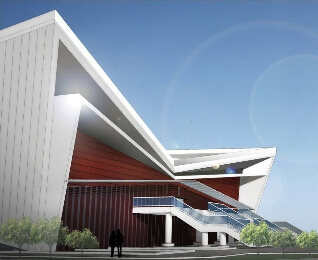
Dapeng Town Industrial Park, Tongshan District, Xuzhou City, Jiangsu Province, China
Achieving ultra-large spans, creating column-free spaces
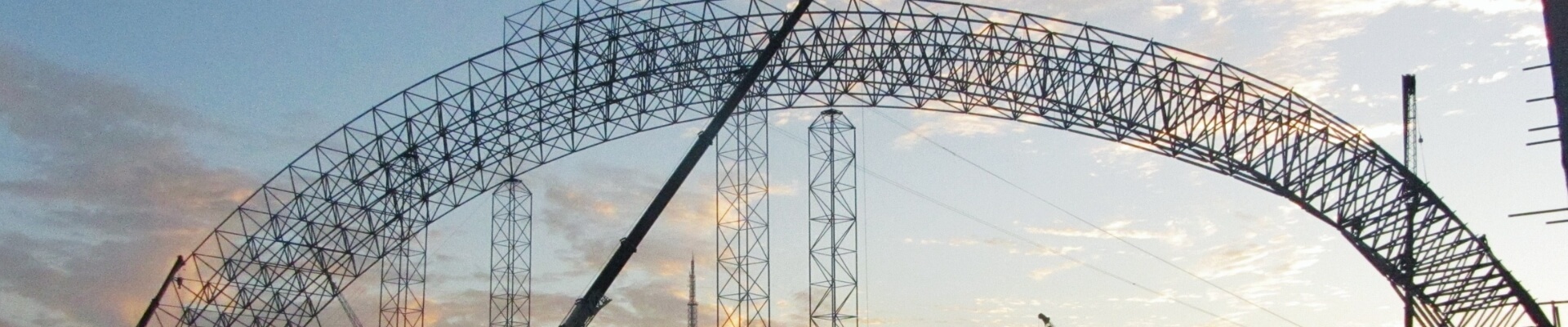
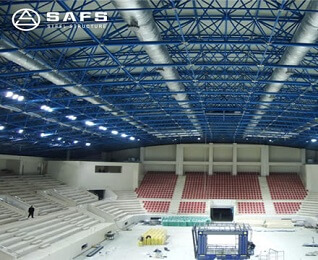
This is the most fundamental advantage. Steel’s high strength-to-weight ratio allows relatively slender structural members to span distances of over a hundred meters. This eliminates interior columns entirely, providing spectators with unobstructed panoramic views while offering maximum flexibility for venue reconfiguration—such as switching between courts of different sizes or setting up stages.
Fast construction speed, short construction period
Steel structural components are primarily prefabricated in factories, ensuring high machining precision and consistent quality. Upon arrival at the site, they are directly lifted into place and assembled like building blocks, significantly reducing on-site wet operations such as concrete pouring and curing. This enables sports venue projects to be completed faster, allowing earlier operational commencement and accelerated return on investment.
Outstanding structural performance, safe and reliable
Excellent seismic resistance: Steel possesses superior toughness and ductility, enabling it to absorb and dissipate seismic energy through deformation. It resists sudden fracture during earthquakes, offering greater safety than brittle materials.
Strong wind resistance: Wind loads on large-span roofs pose a primary challenge. Steel structures’ lightweight yet high-strength properties, combined with their ability to form stable spatial load-bearing systems (such as space frames and trusses), effectively withstand strong wind forces.
High Load-Bearing Capacity: Steel structures can easily support large displays, sound systems, lighting installations, and various catwalks, meeting the functional demands of modern sports arenas.
Flexible styling to meet aesthetic needs
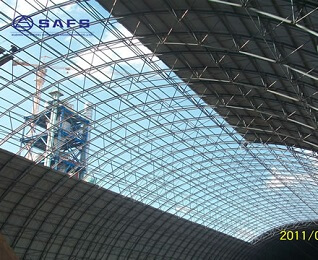
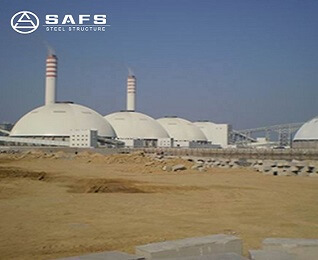
Steel can be factory-prefabricated into standardized components or bent and shaped into fluid curves. This grants architects immense creative freedom to realize iconic forms with dramatic tension and modernity—such as soaring roofs and monumental domes—transforming the stadium itself into an urban work of art.
Environmentally friendly and sustainable
Recyclable Materials: Upon reaching the end of its service life, the steel structure can be 100% recycled, reducing construction waste and aligning with green building principles.
Reduced Foundation Load: Light self-weight means lower foundation requirements, minimizing excavation and concrete usage while reducing environmental impact.
Future Adaptability: The connection methods of steel structures facilitate future expansions, renovations, or functional upgrades.
In summary, steel structures perfectly align with the comprehensive requirements of modern stadiums for functionality, efficiency, and iconic imagery through their integrated advantages in span capacity, speed, safety, aesthetics, and environmental sustainability. This makes them the preferred choice for the primary structure of large-scale stadiums.