
Dapeng Town Industrial Park, Tongshan District, Xuzhou City, Jiangsu Province, China
Disclaimer: This article is for informational and educational purposes only. We did not participate in the design, engineering, construction, or any other phase of the Volksparkstadion project. All data is based on publicly available sources.
Located in Hamburg, Germany, the Volksparkstadion (originally built 1953) underwent a major transformation in 1998 led by Mos Architekten and structural engineers SBP (Schlaich Bergermann Partner). Today, it is a 57,274-capacity multi-purpose venue known for its highly efficient and visually distinctive roof system.
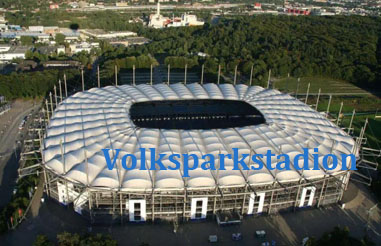
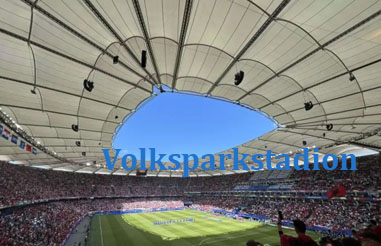
The stadium features a DS-type wheel spoke double-layer cable truss structure combined with a membrane roofing system – a solution that delivers both lightweight spanning capability and architectural elegance. This tensile cable-membrane hybrid is considered a reference example for modern stadium roof engineering.
| Parameter | Value |
| Roof structure type | DS-type wheel spoke double-layer cable truss + membrane |
| Roof area | 36,900 m² |
| Plan dimensions | 240 m (length) × 200 m (width) |
| Roof depth (approx.) | 62 m |
| Roof height (max.) | 59.5 m |
| Seating capacity | 57,274 |
| Original construction | 1953 |
| Redesign / roof completion | 1998 |
| Architect / Engineer | Mos Architekten, SBP |
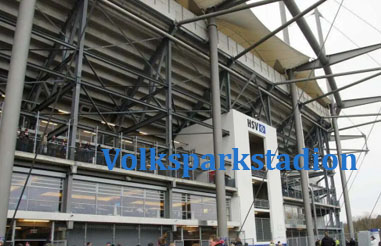
The wheel spoke (bicycle wheel) cable truss topology enables a column-free interior while efficiently transferring loads through tensioned cables and a central compression ring. The membrane cladding provides weather protection, natural light diffusion, and a recognisable silhouette. With a roof spanning 240 m by 200 m and covering 36,900 m², the Volksparkstadion demonstrates how tensile structures can achieve large spans with relatively low dead weight.