

Dapeng Town Industrial Park, Tongshan District, Xuzhou City, Jiangsu Province, China
1.Truss bridge is a type of bridge, which is generally seen in railways and highways. It is divided into two types: upper chord stress and lower chord stress. The truss consists of an upper chord, a lower chord, and a web. The web is divided into an oblique web and a straight web. Since the length-to-slenderness ratio of the rod itself is relatively large, although the connection between the rods may be “fixed connection”, the actual rod end bending moment is generally very small. Therefore, it can be simplified to “hinged” during design analysis. When simplifying the calculation, the rods are all “two-force rods” that bear pressure or tension.
2.Trapezoidal truss Compared with triangular trusses, the trapezoidal truss has improved rod stress conditions, and it can be used in roof trusses to more easily meet the process requirements of certain industrial plants. If the upper and lower chords of the trapezoidal truss are parallel, it is a parallel chord truss. The rod stress condition is slightly worse than that of the trapezoid, but the web type is greatly reduced. It is mostly used in bridges and trestles.
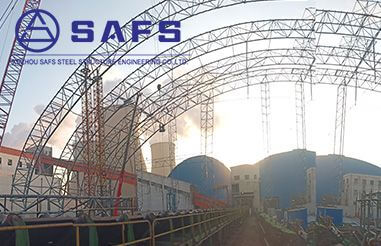
3.Polygonal truss is also called a broken line truss. The upper chord node is located on the quadratic parabola. If the upper chord is arched, the bending moment generated by the inter-node load can be reduced, but the manufacturing is more complicated. Under the action of uniformly distributed load, the truss shape is similar to the bending moment diagram of the simply supported beam, so the axial force distribution of the upper and lower chords is uniform, the axial force of the web is small, and the material is the least. It is a commonly used truss form in engineering.
4.Hollow truss basically takes the shape of the polygonal truss, without diagonal webs, and is only connected to the upper and lower chords by vertical webs. The axial force distribution of the rod is similar to that of the polygonal truss, but the bending moment value of the rod end changes greatly under the action of asymmetric loads. The advantage is that there are fewer rods intersecting at the node, and the construction and manufacturing are convenient.
5.Triangular truss Under the node load uniformly distributed along the span, the axial force of the upper and lower chords of the triangular truss is the largest at the end point and gradually decreases toward the middle of the span, while the axial force of the web is the opposite. Due to the large difference in the internal force of the chord, the material consumption of the triangular truss is not reasonable, and it is mostly used in the roof trusses of tile roofs.