
Dapeng Town Industrial Park, Tongshan District, Xuzhou City, Jiangsu Province, China
In steel structures, the arrangement of secondary beams differs significantly from that in concrete structures. In concrete structures, secondary beams are typically designed as continuous beams to reduce deflection and reinforcement requirements. Since the actual loading on secondary beams is not fully pinned, codes mandate that the negative reinforcement at the ends of secondary beams shall not be less than one-quarter of the bottom reinforcement to prevent negative bending moment cracks.
However, secondary beams in steel structures are generally pinned. Unless constrained by clear height limitations, they are rarely designed as rigidly connected continuous beams. When secondary beams are rigidly connected to primary beams, their upper and lower flanges must be effectively connected to the primary beam or node plate flange to transfer bending moments. Welding is the most common construction method, which presents significant challenges in terms of construction difficulty and workload.
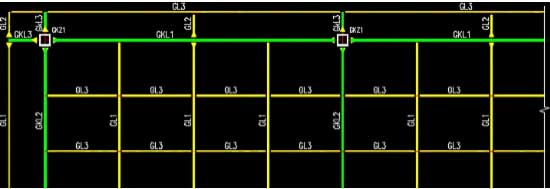
1. In the figure below, the edge beam is rigidly connected to the cantilever beam at its end, which is unnecessary. Furthermore, since the span on the left is not large, there is no need for the intermediate secondary beam to extend out. Instead, the edge beam can be directly supported on the cantilever beam at the frame column.
【Problem Analysis】
Optimize the secondary beam layout by cantilevering every other span. On the north side, use continuous steel edge beams. The intermediate horizontal secondary beams need not be rigidly connected; hinged connections suffice. Given the short column spacing on the left, eliminate the cantilevered secondary beams in the middle and instead extend them directly from the cantilever beams at the column ends.
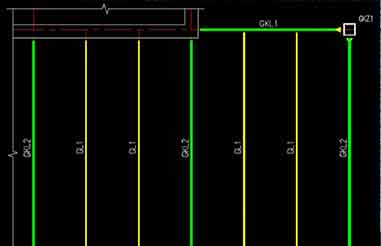
2. The GKL1 frame steel beam has a relatively small span, with a section of H600x300/14×19. Its beam height is identical to that of the larger-span secondary beam GL1 (H800x300x12x16), resulting in sectional waste.
【Problem Analysis】
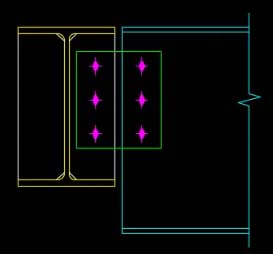
The secondary steel beam GL1 is hinged to the main frame beam GKL1. When the shear strength of the secondary beam’s end web is sufficient, either the node detailing shown in the drawing or a variable-section secondary beam connection method may be adopted. Unless specifically required by the architectural or other disciplines, the main beam’s section height should not be increased solely due to the secondary beam’s section height, as this is not conducive to material conservation.