Dapeng Town Industrial Park, Tongshan District, Xuzhou City, Jiangsu Province, China
Steel trusses can be connected by welding, ordinary bolts, high-strength bolts or riveting. Welding is the most widely used; ordinary screw connection is often used for detachable structures, transmission towers and support systems, high-strength bolt connection is often used for site connection of heavy steel trusses, and riveting is used for heavy steel trusses subjected to large dynamic loads. It has been gradually replaced by high-strength bolt connection.
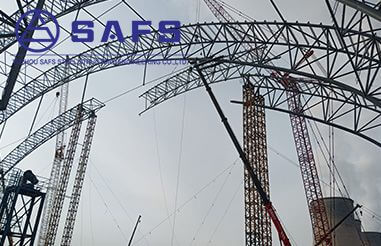
The web bar system of steel trusses usually adopts the form of herringbone or single oblique type. The number of web bars and nodes of the herringbone web bar is small, and it is widely used. In order to reduce the inter-node size of the loaded chord or the compressed chord, some vertical bars are usually added. The single oblique web bar is usually arranged so that the longer diagonal bar is in tension and the shorter vertical bar is in compression. It is sometimes used for steel trusses with larger spans.
If the length of the chord and web bar needs to be further reduced, a subdivided web bar system can be used. When the steel truss is high and the inter-node is small, a K-type or diamond web bar system can be used. In support trusses and towers, a cross-type web system that can better withstand variable-direction loads is often used, and the cross diagonal bars are usually designed as tie rods. The inclination angle of the diagonal web to the chord is usually in the range of 30°~60°.
In order to ensure the stiffness and stability of the plane steel truss outside the truss plane, reduce the calculated length of the chord outside the truss plane, and withstand possible lateral loads, supports should be arranged laterally on the steel truss. Supports can usually be divided into horizontal supports (upper chord and lower chord planes, transverse and longitudinal), vertical supports (at both ends and in the middle of the truss) and tie rods. Pairs of steel trusses can be arranged with transverse horizontal supports along the lower chord and upper chord planes, and vertical supports can be arranged at appropriate intervals on the vertical bar planes at both ends and in the middle of the steel truss.
There are many steel trusses in the roof structure. The upper and lower chord transverse horizontal supports and vertical supports can be set only at the two ends and between the adjacent two trusses at a certain distance. The rest of the trusses only have tie rods set at appropriate intervals on the upper and lower chords. When there is a heavier crane or when necessary, longitudinal horizontal supports can be added between the ends of the lower chord of the truss. In the tower with four or more sides, transverse partitions should be set at a certain height to ensure the rigidity of the tower and the geometric invariance of the cross section.
For steel trusses with a slightly larger span, in order to offset all or part of the deflection under the action of self-weight and load, it is usually required to pre-arch during manufacturing. The arching degree (f) of the roof truss is generally 1/500 of the span.