


Dapeng Town Industrial Park, Tongshan District, Xuzhou City, Jiangsu Province, China
1. What is a rigid cable?
A high-strength cable is a structural member possessing significant bending and compressive stiffness. Unlike flexible cables that only withstand tension, rigid cables can resist partial bending moments under load. They are typically fabricated from solid or lattice steel sections such as structural steel or I-beams. Capable of bearing tensile forces, they also exhibit pronounced bending resistance under localized loads or half-span actions, thereby providing “rigid” support within cable-supported structures.
2. Basic Concepts of Trusses
A truss is a framework structure composed of members connected through pinned joints. Under ideal conditions, all members experience only axial tension or compression forces, with no bending moments transferred between nodes. The mechanical behavior of a truss is entirely determined by its geometry and member cross-sections. Trusses are commonly used in large-span structures like bridges and roof systems to transmit loads in a lightweight and efficient manner.
3. The primary difference between high-strength cables and trusses
| Dimension | High-strength cable | Truss |
| Load characteristics | Simultaneously subjected to tensile forces and a certain bending moment, it possesses bending stiffness. | Subject only to axial tension and compression; the node is pinned and does not transmit bending moments. |
| Connection Method | Use rigid connections by welding or bolting. | The nodes are articulated. |
| Applicable Scenarios | Cable structures requiring a certain degree of rigidity. | Frame structures requiring pure axial force transmission. |
| Force Distribution | Under half-span and local loading conditions, the bending moment is significant while the deflection is relatively small. | The overall stress distribution is uniform, with deformation primarily determined by axial expansion and contraction of the members. |
4. Typical Examples and Illustrations
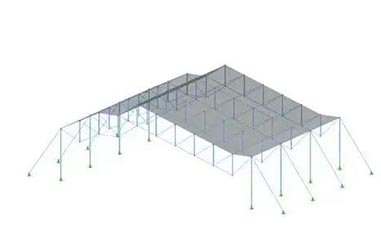
Rigid Cable System Example: The outer shell of Beijing’s National Stadium (Bird’s Nest) employs a grid structure composed of numerous rigid cables (rigid steel cables), providing both tensile support and bending stiffness. The diagram below illustrates the position of the “rigid cable system” within cable structure classifications, clearly demonstrating its rigid characteristics.
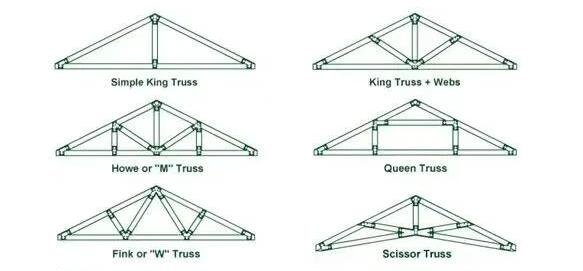
Truss Example: Common steel truss bridges (such as Pratt trusses) consist of triangular members, with all members subjected solely to axial forces. The figure below illustrates several standard truss geometries for comparing their purely axial force characteristics.
5. Summary
Rigid cables: Capable of bearing both tensile forces and bending moments, suitable for cable-supported structures requiring rigid support.
Trusses: Purely axial load-bearing systems, ideal for efficient force transmission in large-span lightweight structures.
Each offers distinct advantages in construction, load-bearing mechanisms, and application scenarios. Engineers select the appropriate system based on specific load characteristics, span requirements, and construction conditions.