Dapeng Town Industrial Park, Tongshan District, Xuzhou City, Jiangsu Province, China
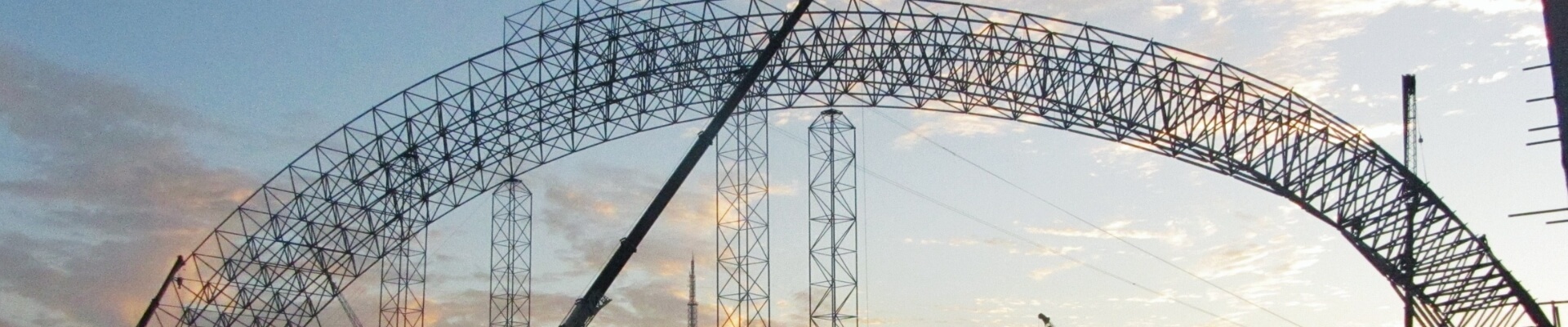
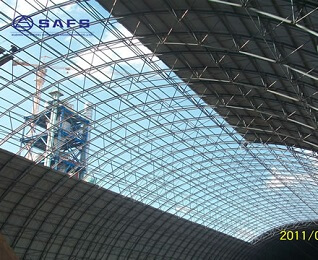
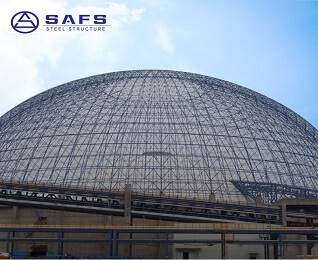
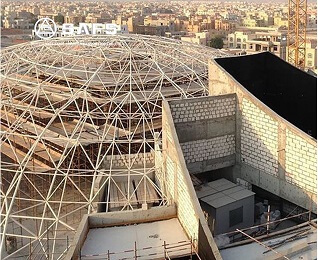
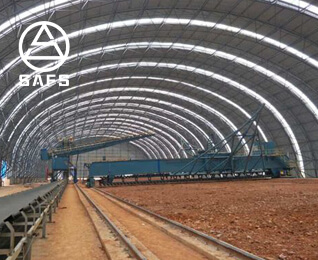
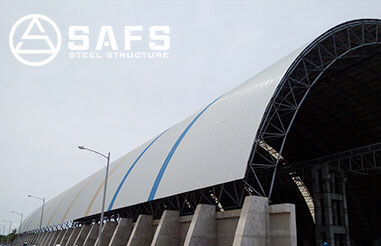
Coal storage sheds are large enclosed structures employed by thermal power stations and coal chemical enterprises for coal storage. Their core functions include rain and dust protection, minimising coal loss, and meeting environmental requirements. Large-span space frame structures (or grid shells, arch structures) represent the mainstream technical solution for achieving these objectives, proving particularly suitable for covering exceptionally large spaces exceeding 60 metres in span, and even reaching over 150 metres.
Functional Requirements:
Must cover the entire coal stockpile area (typically 200–300 metres in length and 80–150 metres in width), with no internal pillars or obstructions to facilitate stacker-reclaimer operations.
Environmental Compliance Requirements:
Enclosed design to suppress coal dust dispersion, prevent coal loss due to rainwater runoff, and avoid water pollution.
Safety and Economic Considerations:
Reduce the risk of coal spontaneous combustion and minimise storage losses.
Functional Requirements:
Must cover the entire coal stockpile area (typically 200–300 metres in length and 80–150 metres in width), with no internal pillars or obstructions to facilitate stacker-reclaimer operations.
Environmental Compliance Requirements:
Enclosed design to suppress coal dust dispersion, prevent coal loss due to rainwater runoff, and avoid water pollution.
Safety and Economic Considerations:
High-efficiency load transfer: As a spatial truss system, the space frame primarily bears axial forces (tension or compression), achieving material strength utilisation exceeding 90% – far surpassing solid beams (30-40%).
Case Study: China’s largest dry coal storage shed spans over 180 metres (e.g., Guodian Changzhou Power Plant employs a double-layer cylindrical space shell with a 136-metre span; some projects employing triple-centre-circle grid shells exceeding 150 metres).
Spatial Synergy: The grid structure creates multi-directional load transfer pathways, enabling rapid dispersion of localised loads across the entire structure.
Deformation Resistance: Minimal deformation under wind loads, coal pile lateral pressure, and seismic forces prevents excessive deformation that could cause tearing of cladding systems (e.g., colour-coated steel sheets).
Reduced steel consumption: The self-weight of a space frame structure is only one-third to one-half that of a traditional steel structure (for a 100-metre span, the steel consumption for a space frame is approximately 35-50 kg/m², whereas a solid-web steel truss requires 60-80 kg/m²).
Reduced foundation costs: Lightweight construction substantially decreases foundation engineering requirements, particularly advantageous for soft ground conditions.
Free-form surface shaping: Adjustable grid patterns enable columnar/spherical shells, folded plate forms, etc., perfectly conforming to coal stockpile contours to minimise dead space (e.g., triple-centre-circle shells reduce freeboard height).
Opening flexibility: Pre-reserved openings within the grid allow for equipment access (e.g., stacker-reclaimer tracks) and ventilation points.
Factory prefabrication: Standardised production of members and joints (bolted/welded spheres) ensures high precision and quality control.
Rapid installation: After ground assembly into units, techniques like overall lifting, sliding, and segmental hoisting minimise elevated work, reducing construction time by 30%-50%.
Integrated utilities: Grid spaces accommodate ventilation, fire protection, and lighting conduits.
Modular expansion: When capacity increases are required, new truss units can be sequentially assembled along the longitudinal direction.
| Structural Type | Span | Advantages | Limitations |
| Space frame/Spherical Shell | 60-200+ | Minimal steel consumption, high rigidity, flexible design | The node design is complex, with stringent inspection requirements. |
| Steel Truss |
30-100+ |
Simple construction, straightforward installation | High steel consumption, poor economic efficiency. |
| Arched Steel Structure | 50-150+ | Visually uncluttered, with excellent load-bearing capacity | Significant horizontal thrust on bearings results in high foundation costs. |
Space frame structures offer distinct advantages in terms of cost-effectiveness, technical maturity and adaptability to span requirements, making them the preferred solution for dry coal storage sheds.