Dapeng Town Industrial Park, Tongshan District, Xuzhou City, Jiangsu Province, China
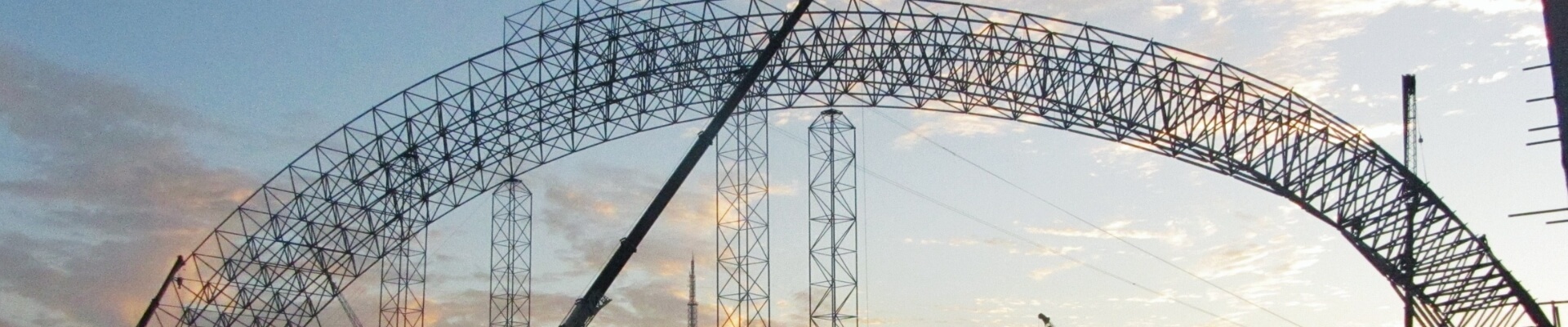
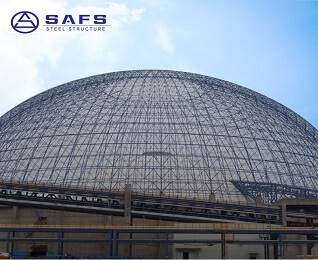
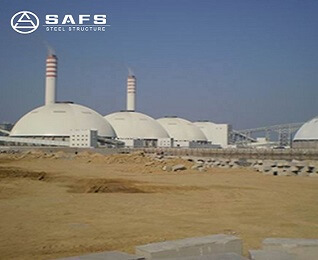
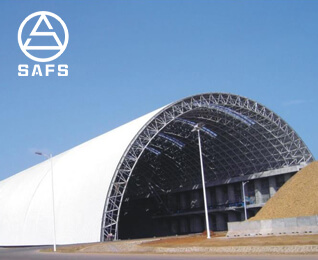
The float glass furnace in glass factories demands extremely high continuity of power supply. A power outage lasting over 5 hours triggers a cold shutdown, directly resulting in economic losses amounting to hundreds of millions of yuan. To avoid fluctuations in grid power, power rationing, or unexpected incidents, enterprises often build their own coal-fired power plants, complete with large-span steel-structured coal storage sheds and metal roofing. Common pain points encountered during actual procurement include:
Span and Load Capacity: Coal storage sheds frequently exceed 80 meters in span. Traditional steel beams, constrained by self-weight and deflection, are prone to structural deformation or local buckling.
Fire Rating: As indoor coal storage facilities, coal sheds fall under Class C fire hazard and require Grade II fire resistance per GB 50229-2019. Fire protection measures are mandatory, including fire-resistant coatings when steel components are ≤3 m from coal piles, with a fire resistance rating of no less than 2.5 hours.
Lightning Protection and Metal Roofing: The metal roof serves both as a lightning conductor and protective layer. Its thickness must not be less than 0.6 mm, and it must form a reliable electrical connection with the main structure to prevent direct lightning strikes inside the coal shed.
Dust Control and Corrosion Prevention: Coal handling generates significant dust. Inadequate corrosion protection for roofs and steel components leads to long-term structural degradation. Dust leakage may also trigger environmental penalties.
Construction Timeline and Costs: Large-scale steel structures require extensive on-site welding and lifting for single-phase construction, resulting in prolonged schedules, high expenses, and unpredictable maintenance costs.
| Key Elements | Design Considerations | Our Values |
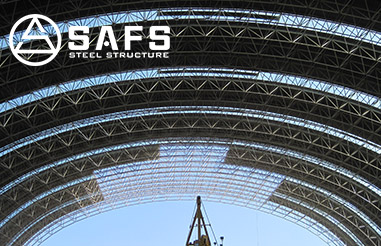
| Large-span steel frame | Constructed with high-strength Q355 steel + prestressed steel strands, with a mesh spacing ≤ 6 m. Nodes are fully welded or secured with high-strength bolts. | Flexible span and compact footprint, capable of storing 300,000 to 500,000 tons of raw coal at once, reducing land costs. |
| Fire Protection | Apply fire-resistant coating (fire resistance rating ≥ 2.5 hours) to all steel components affected by the coal pile (within ≤ 3 m distance), and install fire barriers (width ≥ 10 m) at critical junctions. | Prevent the spread of fires caused by coal dust spontaneous combustion, reduce insurance costs and mitigate potential production downtime risks. |
| Metal Roofing | 1. Use galvanized steel sheets (thickness ≥ 0.6 mm) or color-coated steel sheets with a fluorocarbon topcoat finish; 2. Achieve electrical continuity between the roof and steel frame using bolts + conductive washers. |
1. The metal roof itself serves as a lightning conductor, preventing secondary fires caused by lightning strikes; 2. The anti-corrosion coating extends service life and reduces annual maintenance costs. |
| Lightning Protection System | The roof, steel columns, and support structures shall be uniformly grounded using a lightning protection mesh or lightning protection strip. Independent lightning rods shall be installed at the four corners of the roof to enhance lightning capture efficiency. | Integrated lightning protection systems prevent equipment damage or personal injury caused by lightning strikes. |
| Construction and Delivery | Utilizing prefabricated assembly: On-site operations are limited to lifting and bolting, reducing construction time by 30% compared to traditional welding methods. | Reduce on-site construction time and lower labor costs. |
For the coal storage shed project at the glass factory’s self-owned coal-fired power plant, the core challenge lies in systematically addressing four key requirements: “large span, fire resistance, lightning protection, dust removal, and rapid construction.” By integrating a high-strength prestressed steel frame + fire-retardant coating + aluminized zinc metal roofing + negative pressure ventilation + spray dust suppression + comprehensive lightning protection grounding, the solution not only complies with national standards but also delivers quantifiable value to the purchaser across four dimensions: safety, environmental protection, cost efficiency, and delivery cycle.