Dapeng Town Industrial Park, Tongshan District, Xuzhou City, Jiangsu Province, China
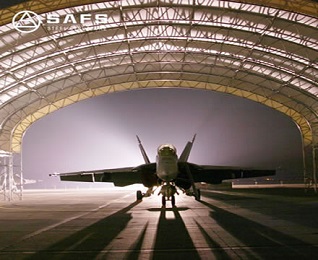
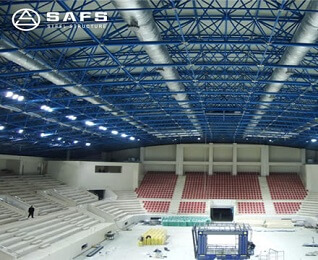
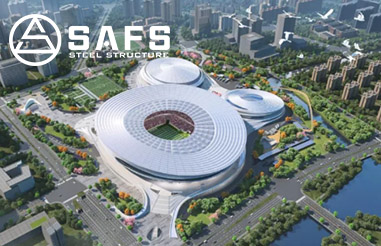
When we gaze upon the majestic grid of a stadium, stroll beneath the colossal dome of a grand theater, or traverse the bright terminals of an airport, we are often awestruck by the expansive, column-free spaces these structures create. Behind these architectural marvels stands a common hero—steel structures. So why do the vast majority of large-span spatial buildings choose steel as their “skeleton”? This stems from steel’s inherent superior properties and significant engineering advantages.
The absolute superiority of material properties
The tensile, compressive, and shear strengths of steel far exceed those of concrete. This means that to achieve the same span, steel components can be designed to be slimmer and lighter. The immense loads are borne by the lightweight structure itself, significantly reducing the pressure on the foundation and lowering the difficulty and cost of foundation treatment. The saying “a feather can move a thousand pounds” vividly illustrates the characteristics of steel structures.
Additionally, steel is a ductile material. When subjected to immense loads or dynamic impacts like earthquakes, it undergoes significant deformation without sudden fracture, buying crucial time for evacuation and emergency response. This “flexibility overcoming rigidity” characteristic is unmatched by brittle materials like concrete and is vital for ensuring the safety of large-span public structures.
Compared to concrete, steel produced through modern industrial smelting offers uniform material composition and stable properties, with highly controllable mechanical parameters. This enables more precise structural calculation models and higher design safety margins, ensuring the reliability of massive building structures at the material level.
Multiple possibilities for structural forms
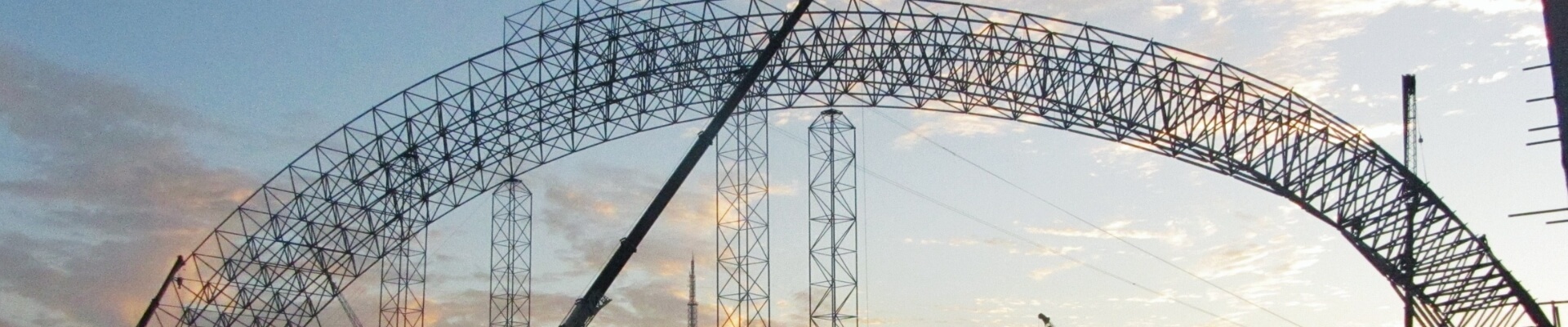
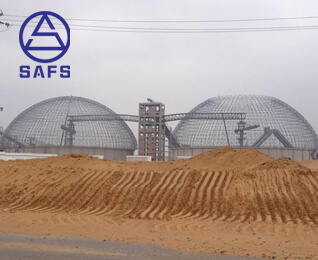
Steel structures are exceptionally well-suited for realizing various highly efficient structural systems, such as space frames, shell structures, suspension bridges, cable-membrane structures, and tensioned beams. These systems efficiently transfer loads to supports through rational force distribution, enabling spans of hundreds of meters and creating unprecedented spatial freedom.
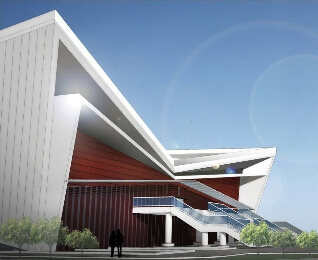
Large-span structures often serve as iconic landmarks requiring distinctive, innovative forms. Steel can be prefabricated into complex curved members and twisted components, precisely realizing architects’ imaginative visions to create fluid curves, intricate surfaces, and tension-rich geometries.
Exceptional efficiency in the construction process
Steel components can be manufactured in factories with high precision and in batches, ensuring consistent quality unaffected by weather or seasonal conditions. On-site work involves only lifting and assembly—like building with blocks—enabling extremely rapid construction. This “dry construction” method significantly shortens the construction cycle, allowing massive structures to rise from the ground in a remarkably short time.
Steel structures exhibit low energy consumption, minimal pollution, and reduced noise during construction. At the end of a building’s lifespan, steel materials can be maximally recycled, aligning with green building principles and sustainable development. Additionally, steel structures facilitate future renovations and expansions of buildings.
In summary, the selection of steel structures for large-span spatial architecture is not coincidental. It represents an inevitable choice driven by advancements in materials science, structural mechanics, and engineering economics—a pursuit of larger, taller, lighter, and more liberated spatial exploration. Steel structures embody the pinnacle of modern industrial civilization, achieving a perfect fusion of strength and beauty.