Dapeng Town Industrial Park, Tongshan District, Xuzhou City, Jiangsu Province, China
With years of experience in Kenya’s industrial infrastructure market, we understand the heavy burden that local EPC contractors carry on every project—caught between challenging local conditions, unstable supply chains, and long-term operational pressures. Despite substantial investments of capital and manpower, countless EPC firms still find themselves trapped by project delays, cost overruns, and shortened facility lifespans. These persistent pain points continue to undermine project delivery quality across the board.
The first and most fundamental challenge is structural designs that fail to account for Kenya‘s unique geological and climatic conditions. Kenya spans multiple seismic zones—Nairobi, Nakuru, and other regions require higher seismic design standards. Coastal Mombasa faces year-round salt spray erosion from the Indian Ocean, while inland areas experience heavy short-duration rainfall during the rainy season, leading to site flooding and foundation settlement. Many overseas design teams simply apply generic factory blueprints without tailoring solutions to local soil bearing capacity, seismic ratings, or corrosion protection requirements. The result? Foundation rework, roof corrosion and leakage, and insufficient seismic capacity in beams and columns. Once construction is underway, structural modifications mean having to halt work and re-adjust the design. Additionally, there would be numerous changes required on-site—stretching delivery timelines and directly squeezing EPC contractor profit margins.
Notably, Kenya‘s infrastructure deficit is estimated at approximately Sh647 billion ($5 billion) annually. With the government unable to take on additional debt, the pressure on EPC contractors to deliver cost-effective, durable solutions has never been greater. Parliament has recently called for the termination and blacklisting of contractors responsible for persistent project delays—citing contractor underperformance, governance challenges, and rising construction costs. In this environment, getting the structural design right from day one is not just good practice—it‘s essential for survival.
The second major challenge is the instability of East Africa’s building material supply chain, which throws both cost and schedule into disarray. Kenya‘s domestic steel production capacity is limited—high-strength sections and corresponding enclosure panels are heavily dependent on imports. In 2022 alone, Kenya imported Sh15.94 billion worth of steel products. Tight shipping capacity, unpredictable port clearance cycles, fluctuating Kenyan shilling exchange rates, and rainy season logistics disruptions frequently result in material shortages and idle labor.
The dollar was trading at approximately Ksh 129 in May 2026, and steel reinforcement bars were priced at 90,000–120,000 Ksh per ton. These exchange rate fluctuations directly impact the cost of imported structural steel. Most EPC firms lack upfront procurement coordination; emergency air freight for supplementary materials costs several times more than sea freight. Alternatively, opting for locally sourced low-standard materials introduces structural safety risks—trapping contractors in an impossible dilemma between “expensive delays” and “cheap but dangerous.” Project budgets are nearly impossible to maintain under these conditions.
The third major pain point is the absence of local long-term maintenance support after factory handover. Kenya suffers from a shortage of specialized steel structure maintenance technicians. Many EPC contractors terminate support services immediately after project completion and handover. Three to five years later, Corrosion-resistant coatings peel, roofs leak, and connection joints loosen—with no one equipped to address these issues efficiently.
Industrial factories house continuous production lines. When structural failures force a shutdown, the factory incurs enormous daily losses from halted production. Overseas suppliers have long response cycles for after-sales service, and spare parts shipping takes considerable time—severely disrupting the owner‘s production schedules while putting sustained reputational pressure on the EPC contractors who delivered the project.
Facing these three long-standing challenges in Kenya‘s factory EPC projects, SAFS Steel Structure has already deeply penetrated the East African market for years, developing a complete solution that encompasses localized custom design, integrated containerized building material supply, and full-cycle maintenance support.
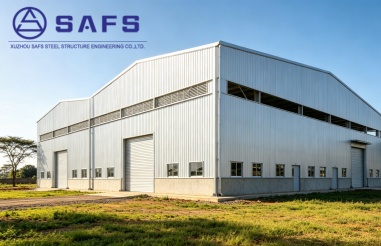
All our factory structural solutions are benchmarked against Kenya’s seismic and corrosion protection codes. We conduct site geological surveys in advance to optimize foundation designs. All steel components are prefabricated in our domestic factories, consolidated into full-container shipments with locked sailing schedules to avoid logistics delays, and rigorously controlled for overall cost. Meanwhile, we station local technical teams on-site to provide long-term inspection, repair, and spare parts supply services—completely eliminating after-service dead zone.
From agricultural processing plants and light manufacturing workshops to warehousing and logistics parks, SAFS Steel Structure has delivered a substantial portfolio of complete steel structure factory projects across Kenya. Recent developments underscore the growing demand: the Sagana Industrial Park in Kirinyaga County has completed construction of eight warehouses, including cold storage, aggregation, and value-addition facilities. The Murang‘a Industrial Park has seen six companies begin constructing manufacturing plants. Vipingo Special Economic Zone in Kilifi County, a 2,000-acre hub located 42 km from Mombasa, is expected to attract Sh390 billion in investment. These projects create immediate and ongoing demand for reliable steel structure solutions.
Additionally, the Nairobi–Malaba Standard Gauge Railway Phase 2 (Naivasha–Kisumu section), a flagship Belt and Road project undertaken by China Communications Construction, officially broke ground in March 2026. With a main line length of 263.75 km and designed annual freight capacity of 22 million tons, this project will further accelerate Kenya‘s industrialization and drive sustained demand for industrial facilities along the corridor. We have accumulated a wealth of field-verifiable case studies tailored to the East African market, offering every EPC partner stable, worry-free, and cost-effective integrated steel structure solutions.
Contact Xuzhou SAFS Steel Structure Engineering Co., Ltd. (SAFS)
Specializing in steel structure engineering, pipe truss engineering, space frame engineering, welded ball space frames, trestle engineering, and related fields.
Official website: https://www.safsteelstructure.com