
Dapeng Town Industrial Park, Tongshan District, Xuzhou City, Jiangsu Province, China
When it comes to steel structure projects, the most expensive material is rarely the best choice, and higher strength doesn‘t always mean a better fit. Many project teams face a dilemma:blindly specifying high-grade steel drives up budgets, while chasing the lowest price often leads to structural deficiencies and costly repairs down the line. Three steel grades dominate overseas infrastructure projects today—Q355B, Q420, and S355JR. Each differs significantly in performance, best-use scenarios, and cost. Getting the selection right is the first and most critical step toward cost-effective, reliable project delivery.
Amid ongoing raw material price volatility throughout 2025, global iron ore prices contracted 4% year-on-year, coking coal declined 26%, and steel scrap decreased 8%. Yet prices rebounded from Q1 to Q2 2025 by 3.15%, though they remained down approximately 10.5% year-over-year. For construction buyers, the window for optimized procurement strategies has never been more critical. Meanwhile, CBAM’s payment phase began on January 1, 2026, embedding carbon costs directly into imported steel pricing—meaning material selection now directly impacts not only project budgets but also customs clearance expenses. In this environment, precision material selection is no longer just best practice—it’s essential for project survival.
A common mistake among engineering teams is defaulting to a single steel grade for every application. Under otherwise normal working conditions, unnecessarily specifying high-strength steel leads to severe over-engineering, inflating material procurement and fabrication costs for no structural benefit. On the other hand, selecting low-cost steel for critical load-bearing applications risks insufficient load capacity, compromising stability and creating safety hazards that can derail final approvals. Misaligned material selection is a primary, often invisible driver of budget overruns and repeated design revisions on overseas projects.
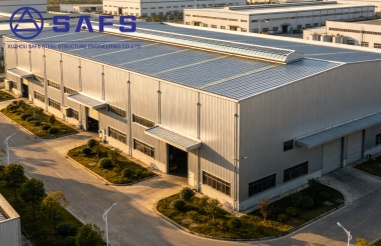
As a versatile and cost-effective grade, Q355B is the steady choice for routine infrastructure projects. Defined by standard GB/T 1591-2018, Q355B has a minimum yield strength of 355 MPa and tensile strength of 470–630 MPa. It is characterized by mature processing technology, stable supply chains, and excellent weldability, making it well-suited to most conventional applications—ordinary factory buildings, ancillary frames, lightweight stands, and auxiliary steel structures. For typical non-large-span, non-high-load scenarios, Q355B fully meets design standards while delivering stable performance at an accessible cost. It delivers the ideal balance of practicality and economy for foundational steelwork.
S355JR, compliant with European standard EN 10025-2, is the go-to material for export-oriented projects, seamlessly aligning with EU and Southeast Asian engineering specifications. Its low-temperature toughness and structural stability make it particularly well-adapted to diverse overseas climates. Its greatest value lies not in superior mechanical properties—S355JR is broadly equivalent to Q355B in strength—but in its compliance with international acceptance systems. S355JR helps teams avoid costly rework and customs clearance delays caused by mismatched material standards. This makes it the preferred choice for overseas public buildings, commercial venues, and medium to small-span export projects.
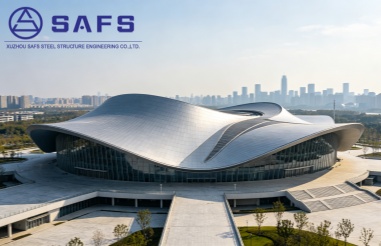
Q420 high-strength low-alloy structural steel, also compliant with GB/T 1591-2018, has a minimum yield strength of 420 MPa and tensile strength of 520–680 MPa. Its higher yield strength allows for reduced member cross-sections and lighter structural weight while supporting larger loads, making it ideal for core structural applications such as ultra-large-span venues, heavy industrial frameworks, and major load-bearing components. Although the per-ton cost of Q420 is higher, its use can significantly reduce overall tonnage, creating lighter, more stable structures for complex projects—where even a 10–15% higher material cost can be offset by weight reduction savings that improve overall project ROI.
Smart material selection follows a simple but powerful principle: match the material to the actual working conditions, not to habit or guesswork. Abandon the one-size-fits-all approach. SAFS Steel Structure, with years of experience in overseas projects, has deep insight into the performance distinctions among these three steel grades and the varying acceptance standards across target markets. Drawing on real working conditions, load parameters, project budgets, and local codes, we develop scientifically optimized material selection strategies for every project—economical where appropriate, high-strength where necessary—eliminating both performance waste and safety shortfalls.
No blind over-specification. No corner-cutting. SAFS applies rigorous engineering judgment to balance safety and cost. With a full-scale production and processing system and an experienced overseas construction team, we deliver value-driven, custom solutions for every client. Through precision material selection, we help overseas projects achieve higher quality with tighter cost control—ensuring every ton of steel delivers maximum value.
Contact SAFS Steel Structure Engineering Co., Ltd. (SAFS)
Specializing in steel structure engineering, pipe truss engineering, space frame engineering, welded ball space frames, trestle engineering, and related fields.