
Dapeng Town Industrial Park, Tongshan District, Xuzhou City, Jiangsu Province, China
Situated at the crossroads of Europe and Asia, Turkey’s varied terrain—ranging from rugged mountains to river valleys—has long presented challenges for local infrastructure builders. For power plant developers, the ability to construct robust structures that can adapt to diverse site conditions is essential. In response, pipe truss structures have been increasingly adopted across the country’s energy sector.
Turkey’s energy infrastructure is entering a period of historic expansion. According to the 2026 public investment program published in the Official Gazette, state‑owned enterprises and their subsidiaries will invest a total of ₺679.4 billion (approximately $22.7 billion) in 2026—the largest scale since 2018. Energy‑related companies dominate this plan, with planned outlays of about ₺473.6 billion (roughly $11.28 billion), accounting for nearly 70% of the entire public investment budget 70%. Furthermore, the government has outlined plans to allocate up to $30 billion over the coming decade toward grid and energy storage infrastructure.
Turkey aims to reach 120,000 MW of solar and wind capacity by 2035, with a corresponding $30 billion investment in supporting infrastructure. The first offshore wind tender is also scheduled for 2026, with the government designating this year as the “Year of Wind”. At the same time, domestic coal plants are receiving a purchase guarantee from 2026 through 2029, ensuring stable baseload generation and driving sustained demand for power plant construction.
The Turkish construction industry is projected to expand by 6.4% in 2026, supported by robust investment in transport and energy projects. Turkey‘s steel market was valued at $15.33 billion in 2023 and is projected to grow at a CAGR of 5.27% through 2029, with structural steel products playing a crucial role. For international steel structure suppliers, this presents a clear window of opportunity.
Turkey’s northern regions are cold and humid, while the south endures dry, scorching heat. Significant temperature swings induce stress deformation in building structures, and the soft soil of river valleys and slopes often leads to settlement and distortion in ordinary steel frames
Adding to these challenges, Turkey is located in one of the world‘s most active seismic zones. The country’s building codes demand strict seismic performance for all critical facilities. Power plants, as lifeline infrastructure, must be designed to withstand strong ground motions without loss of function
Thus, any solution adopted for power plant construction must deliver exceptional load capacity, deformation resistance, and seismic resilience across diverse environmental conditions
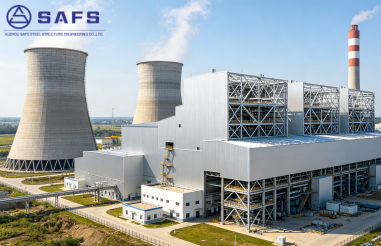
Drawing on extensive experience in the power plant sector, SAFS Steel Structure has developed a mature pipe truss construction technology that precisely matches the varied working conditions of Turkish power plant projects
1. Optimized Structural Performance for Natural Environments
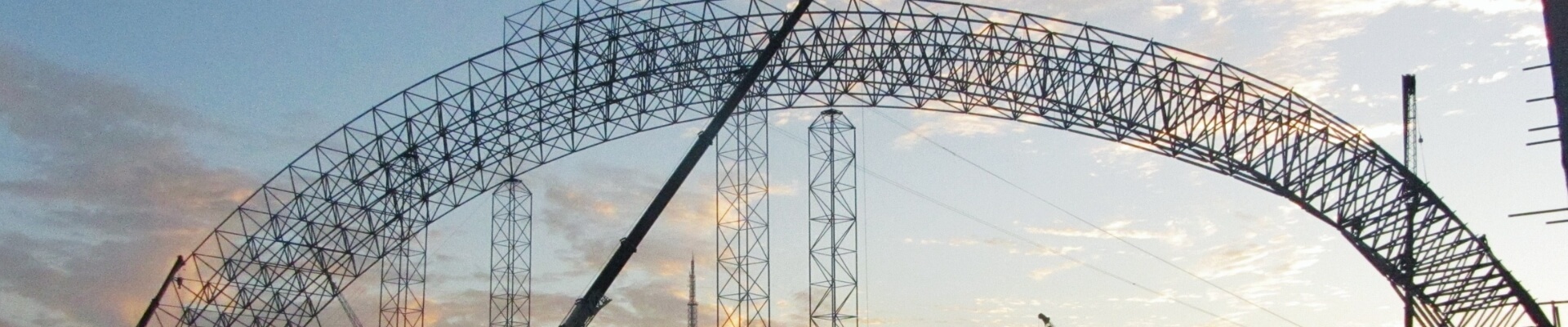
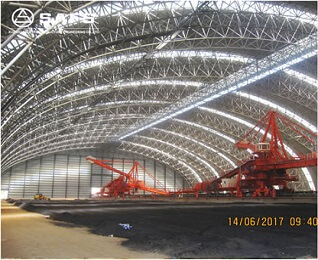
SAFS’s pipe truss solution utilizes seamless steel pipes welded into a hollow load‑bearing configuration that integrates both flexibility and strength. The triangular truss geometry efficiently distributes loads, resists bending and torsion, and adapts to uneven construction foundations. This design withstands corrosion in the humid northern climate, endures high‑temperature exposure in the south, and possesses the inherent ductility to absorb seismic energy without brittle failure.
2. Simplified and Flexible Construction
Power plant galleries, skylight roofs, and conveyor corridors are often constrained by limited site space on uneven terrain. Traditional heavy steel structures require complex hoisting and on‑site welding, leading to delays and logistical challenges.
SAFS’s pipe truss system uses standardized split components with light weight, enabling convenient transportation without the need for large heavy machinery, and rapid assembly even in tight spaces. Compared to conventional steel frames, the construction process is reduced by more than 30% , helping project managers avoid additional costs from delays and space constraints.
Leading power plant projects in Turkey have already demonstrated the benefits of advanced prefabrication. For the Akkuyu Nuclear Power Plant—Turkey’s first nuclear plant—turbine hall roof trusses weighing between 110 and 200 tons each were pre‑assembled on‑site simultaneously on two jigs before being lifted into place by crawler cranes. This prefabrication approach reduced on‑site welding, maintained quality control, and accelerated construction—principles that SAFS applies to conventional power plant projects as well.
3. Economical and Durable Throughout Lifecycle
SAFS optimizes steel ratios in its pipe truss designs to reduce raw material costs while maintaining structural integrity. The surface is coated with a high‑temperature oxidation‑resistant finish that resists weathering and abrasion, eliminating the need for frequent maintenance and repainting. Compared to traditional solid steel frames, the integrated pipe truss solution offers lower overall costs and a longer service life, substantially reducing long‑term operational expenses for power plant owners.
Notably, Chinese steel structure suppliers have already successfully served the Turkish market. Hu Nute Lu Power Plant in Adana Province (2×660 MW) relied on Chinese fabrication for its auxiliary plant steel structures. In 2026, the same plant announced tenders for technical supervision and management services for its 2026–2028 operational period, indicating ongoing O&M demand.Meanwhile, Turkey’s Tufanbeyli Thermal Power Plant expansion (adding 450 MW by 2026), led by Enerjisa, is currently the country’s only significant new coal project under active construction. These examples highlight sustained opportunities for specialized steel structure providers in Turkey’s energy sector.
Turkey has several established domestic steel structure manufacturers. TREYSAN PREFABRİK provides steel structures for power transmission towers, substations, pipe racks, and power plant structures. GULERMAK Steel Construction operates a factory with a capacity of 30,000 tons/year for steel structures and pressure vessels. Çimtaş, a fully owned subsidiary of ENKA, fabricates steel structures, bridges, wind towers, and offshore components to ASME, AISC, and other international standards. Yücel Group, with five production facilities, has been a leader in the iron, steel, and pipe industry in Turkey since the 1950s. UZAY SISTEM, established in Istanbul in 1986, offers turnkey projects from design to construction.
Given this competitive landscape, SAFS differentiates itself through:
Custom engineering for complex terrain and seismic conditions —not mass‑produced standard designs.
Superior corrosion protection tailored to Turkey‘s varied climates (northern humidity vs. southern heat).
Cost‑effective global sourcing combined with Turkish and European certification pathways.
With a comprehensive production and processing system and an experienced overseas construction team, SAFS Steel Structure is committed to a win‑win partnership approach. We look forward to collaborating closely with Turkish contractors to deepen our presence in the power infrastructure market and build high‑quality power plant projects together.
Contact Xuzhou Sufang Steel Structure Engineering Co., Ltd. (SAFS)
Specializing in steel structure engineering, pipe truss engineering, space frame engineering, welded ball space frames, trestle engineering, and related fields.