Dapeng Town Industrial Park, Tongshan District, Xuzhou City, Jiangsu Province, China
After years of market volatility and industrial consolidation, 2026 has brought significant signs of recovery to the global steel structure market. According to Grand View Research, the global structural steel market was valued at USD 123.37 billion in 2025 and is projected to reach USD 202.06 billion by 2033, with a compound annual growth rate (CAGR) of 6.7% from 2026 to 2033. Another report from 360iResearch shows the market grew from USD 144.14 billion in 2025 to USD 153.77 billion in 2026, with expectations to reach USD 236.35 billion by 2032 at a CAGR of 7.32%. The structural steel fabrication market is growing even faster, from USD 179.04 billion in 2025 to USD 195.5 billion in 2026 at a CAGR of 9.2%. Meanwhile, the global prefabricated building and structural steel market reached USD 260.6 billion in 2025 and is projected to hit USD 405.5 billion by 2034.
Overseas infrastructure investment is heating up, the new energy industry is rapidly expanding, and urban renewal projects are accelerating—all working in tandem to drive steady growth in global steel structure orders. This recovery, however, is not a simple return to the past. The market has moved beyond mere incremental growth, and a quiet structural upgrade is reshaping the underlying logic of competition across the entire steel structure industry.
Looking across global markets, a clear trend of demand divergence is emerging. Traditional real estate-oriented steel structure projects continue to lose ground, while low-end, homogeneous industrial buildings are trapped in increasingly brutal price wars. On the other hand, emerging sectors such as new energy support infrastructure, high-bay warehousing, multifunctional public buildings, and retrofits of existing structures are growing rapidly and becoming core drivers of growth for the steel structure industry.
The 2026–2030 period is expected to see average annual new steel consumption of 17.48 million tons for wind power, 10.34 million tons for solar power, and 260,000 tons for energy storage. In response to these opportunities, steel structure industry revenues are projected to reach approximately RMB 838.9 billion (about USD 116 billion) in 2026, with an annual growth rate of 6.3%. Production volume is expected to exceed 140 million tons, maintaining a compound annual growth rate of more than 8%. New energy (solar/wind/storage) plants, high-standard logistics warehouses, data centers, urban renewal projects, and prefabricated housing have become the main incremental drivers. The industry penetration rate in the construction sector is rising from 12.3% to 14%. These emerging projects are no longer driven solely by lowest-cost considerations; rather, they are demanding an end to crude, high-waste construction thinking
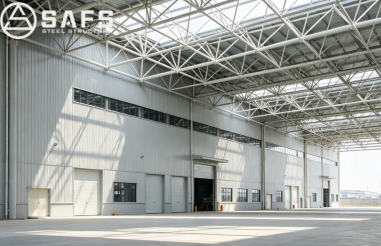
The shift in demand has directly driven the full-scale evolution of structural forms. In the past, overseas projects commonly favored simple, loose-assembly steel frames, which carried large redundancy and limited adaptability, meeting only basic building needs. Today, however, clients increasingly prefer lightweight, modular, highly adaptable structural systems that combine large-span load-bearing capacity, low-carbon attributes, and flexibility for future modifications. These new structures can adapt to complex conditions such as humid tropical coastal environments and soft-soil island foundations, while also meeting low-carbon construction standards under evolving global carbon border policies.
The logic behind structural design has also undergone fundamental change. Where design once focused primarily on meeting static load-bearing requirements, today’s project owners are adopting a full-life-cycle perspective, taking into account seismic performance, weather resistance, disassembly and reuse capabilities, ongoing maintenance costs, and end-of-life green recycling. A one-size-fits-all structural approach no longer holds appeal in the market; instead, custom-designed solutions built on a project-by-project basis have become the standard for high-value overseas projects.
As market opportunities shift toward higher-value segments, the entry barriers for cooperation are also rising. From 2026 onward, as the full implementation of the EU Carbon Border Adjustment Mechanism (CBAM) takes effect and free quota phase-out accelerates, carbon-related fees will be applied to imported steel and steel-containing products. The default emissions values set by the policy often exceed 3 tons of CO₂ per ton of steel, and these values will increase by 10% annually from 2026 to 2028. This creates a direct incentive for market participants to prioritize suppliers with proven low-carbon production capabilities. For companies lacking supply chains certified for their carbon footprint, the ability to compete in regulated markets will be severely constrained. Under this new policy framework, carbon certification is rapidly becoming as fundamental as quality control in securing international project contracts.
The reallocation of market opportunities toward higher-value segments has also substantially raised the bar for collaboration. The ability to manufacture alone can no longer meet the demands of this new era. Clients increasingly prefer one-stop suppliers capable of offering integrated services across design, material selection, prefabrication, and on-site installation. This shift is steadily squeezing out small and medium-sized manufacturers that compete solely on low price, while industry resources continue to concentrate among comprehensive, leading players.
The strategic direction for the steel structure industry in 2026 is clear. As industry resources continue to consolidate toward leading players, competitive advantages will be defined by the ability to provide full-process services from design to after-sales support, combined with supply chain resilience, digital engineering capabilities, and authentic green credentials. It is this environment that separates firms capable of capturing premium opportunities from those that remain stuck in low-margin price competition.
Following the market trend and rising with the opportunities, SAFS Steel Structure, with its deep roots in overseas markets, has keenly captured the forces reshaping the industry and has proactively completed a comprehensive upgrade of its technology and services. Moving away from outdated, inefficient structural systems, the company has adopted digital design methods, refined modular and lightweight solutions, and adapted its approach to serve diverse emerging markets such as new energy, high-end industrial buildings, and public infrastructure projects.
Drawing on extensive experience serving overseas local markets, SAFS can tailor custom, high-value structural solutions to the specific design codes, climate conditions, and low-carbon requirements of different countries. At this critical moment of transition within the steel structure industry, SAFS is committed to embracing market change through upgraded product quality and service excellence, helping global partners seize the benefits of recovery and share in the promise of high-quality growth in the new steel structure cycle.