Dapeng Town Industrial Park, Tongshan District, Xuzhou City, Jiangsu Province, China
Egypt’s land transport network is expanding rapidly. In 2026, this ancient civilization is advancing its transport infrastructure modernization at an unprecedented pace. According to Ahram Online, President El-Sisi inaugurated the Bashteel Railway Station in April 2026. Located in northern Giza, this modern station is four times larger than the historic Ramses Station, featuring 12 railway tracks with a daily passenger capacity of 250,000, and integrating Cairo Metro Line 3, the monorail, and the BRT system—marking a milestone in Egypt’s railway hub upgrades. Almost concurrently, the East Nile Monorail—Africa’s first straddle-type monorail system—commenced commercial operations, extending 56.5 kilometers from Cairo Stadium Station to the Control and Operations Centre in the New Capital. Earlier, the third phase of Shenzhen Metro Group’s overseas project, Egypt’s 10th of Ramadan City Railway Phase 3 Part A, successfully opened, spanning 19.2 kilometers with four stations.
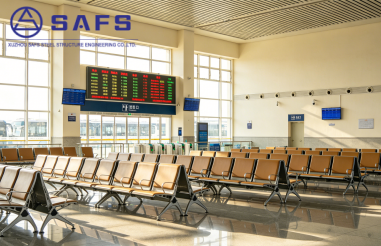
Amid this large-scale infrastructure wave, railway station waiting halls, as urban gateways for passenger flow, bear the dual mission of commuter service and city image representation. Egypt’s unique tropical desert climate and increasingly stringent public building standards present numerous practical challenges for construction parties. Traditional construction solutions fall short in balancing environmental adaptability and construction cost-effectiveness, hindering project realization.
Egypt enjoys abundant sunshine year-round, with a long hot season bringing dry heat over every station. Traditional concrete and ordinary steel roofs absorb heat intensely, creating sweltering conditions inside the halls. As reported by the World Bank’s RISE project, railway modernization in Egypt is a long-term process, and summer waiting experiences directly impact passenger satisfaction and station operation efficiency. Crowded passenger flows coupled with high temperatures result in poor waiting experiences; meanwhile, ventilation and cooling equipment running under sustained high loads continuously drives up energy costs, placing heavy burdens on ongoing operations and maintenance.
Steel Space Frame Solution — Combine solar reflective coating technology with passive ventilation design. Modern solar reflective insulation coatings use a triple mechanism—reflecting solar radiation in the 400–2500 nm range, radiative heat dissipation, and hollow microsphere insulation—to achieve a solar reflectance of over 85% and a hemispherical emittance of over 83%, reducing surface temperatures by more than 20°C while offering waterproofing, anti-corrosion, and decorative functions. When such high-performance coatings are applied to steel space frame roofs, combined with the natural ventilation characteristics of the space frame structure, heat gain inside the hall can be significantly reduced. Target Engineering’s acrylic thermal insulation coatings have been proven effective in Egypt‘s scorching summers, reducing cooling costs by up to 30%.
News Connection — The HVAC system for Egypt’s high-speed rail project features a massive solution with a total cooling capacity exceeding 11,000 refrigeration tons, specially designed for Egypt’s high-temperature climate. This indicates that Egyptian rail operators are raising their standards for station environmental quality, giving steel space frame waiting halls with efficient thermal insulation technologies a competitive edge.
Egypt experiences significant day-night temperature differences, and the air carries desert dust and trace salts, creating dual corrosive conditions. High chloride concentrations in coastal air along the Mediterranean and Red Sea severely corrode steel, while Sahara sandstorms produce physical abrasion effects. Standard building materials cannot withstand repeated thermal expansion and contraction, leading to surface weathering, flaking, and component rusting and aging. Waiting halls, as high-frequency public buildings, incur not only high repair costs but also disrupt normal station operations when frequently maintained, trapping contractors in after-service maintenance dilemmas.
Steel Space Frame Solution — Implement a dual protection system of hot-dip galvanizing + heavy-duty anti-corrosion coating. Weathering steel has limited corrosion resistance in high-salinity coastal areas; a more optimal choice is hot-dip galvanizing (20–30 years of corrosion protection) or multi-layer composite coating systems with a designed lifespan of over 50 years. Steel structure anti-corrosion is critical for ensuring durability, requiring comprehensive solutions from four perspectives: material resistance, surface sealing, structural design, and ongoing maintenance.
News Connection — Egypt‘s Ministry of Industry has introduced a package of investment incentives to encourage the construction of cold-rolled steel, galvanized steel, and color-coated steel production plants, aiming to reduce import dependence and enhance supply chain resilience. Egypt’s annual steel demand gap is approximately 3 million tons, with premium H-beams almost entirely dependent on imports. However, Baowu Group‘s hot-rolled H-beams have already passed the Egyptian Organization for Standardization (EOS) certification, fully complying with local seismic building standards.
Waiting halls need to accommodate dense passenger flow, requiring open and spacious layouts. Traditional concrete structures have high self-weight and many support columns, which not only reduce available space for passenger movement and rest but also feel visually oppressive and hinder passenger flow management. Rigid designs cannot adapt to station modernization needs, making it difficult to balance aesthetics and space utilization.
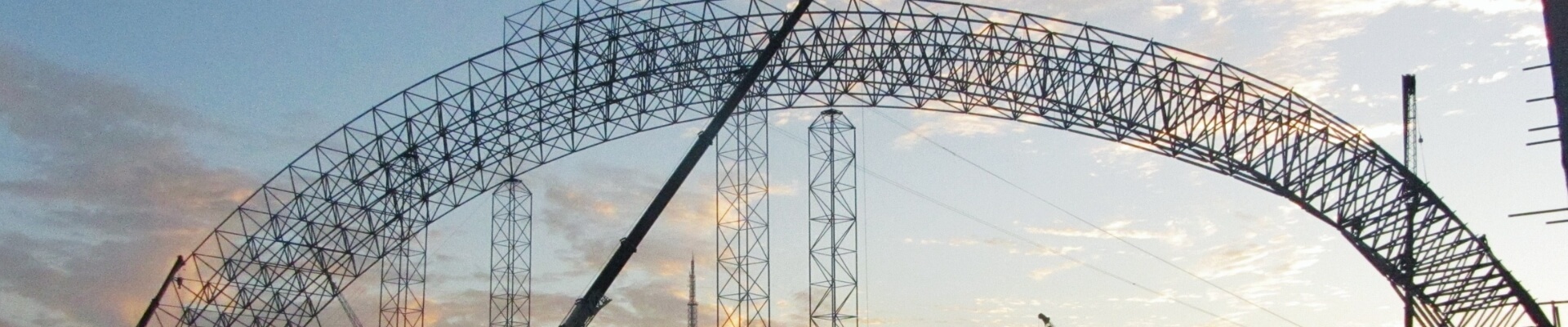
Steel Space Frame Solution — Achieve large-span, column-free spaces with space frames. Space frame structures distribute loads evenly through a three-dimensional load-bearing system, eliminating internal support columns and achieving spans of up to 100 meters or more of column-free space. This column-free design significantly improves space utilization, facilitating passenger flow, commercial layout, and flexible configuration of various facilities. The small cross-sections and compact joints of space frames do not consume excessive clear height, fully releasing both vertical and horizontal interior space. Meanwhile, space frames offer flexible, varied forms that perfectly meet the modern architectural design requirements of Egyptian stations—whether the pharaonic glass pyramid style of Bashteel Station or other iconic station designs, steel space frames can realize architects‘ visual visions.
Technical Data Support — Large-span steel space frame roof structures enable extensive natural daylighting. Combined with high side windows and high-transparency skylights, they significantly improve indoor illuminance uniformity, drastically reducing artificial lighting needs during daytime hours. For example, the Xi’an East Station in China features seven skylights each averaging 700 square meters on its metal roof, serving as the main daylighting and thermal insulation system for the waiting hall. Similar design concepts can be readily adapted to Egyptian station projects.
New Egyptian stations are often located in urban traffic corridors with limited construction space and strict project timelines. Traditional building materials are heavy and require complex installation processes, generating construction waste and causing traffic congestion during construction, indirectly increasing labor and time costs while complicating project management. The Phase 3 of the 10th of Ramadan City Railway project, undertaken by a consortium of AVIC International, Egypt‘s Arab Contractors, and Orascom Construction, has an estimated investment of $550 million and a design daily passenger capacity of 500,000. Such large-scale infrastructure projects demand extremely high construction efficiency.
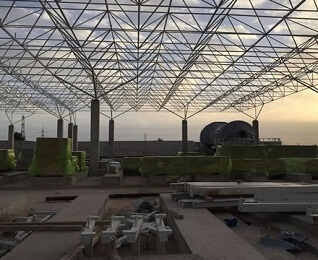
Steel Space Frame Solution — Factory prefabrication and modular on-site assembly. Space frame structures can be precision-fabricated in factories and assembled on-site, significantly reducing high-altitude work and on-site construction complexity. The modular production approach improves construction efficiency while effectively shortening timelines. In the 10th of Ramadan City Railway project, the Shenzhen Metro team completed critical tasks—including clearance detection, cold-sliding testing of the catenary, power supply energization, and hot-sliding commissioning of electric trains—within just over a month, ensuring the project opened on schedule.
Technical Data Support — Modern steel space frame construction can dramatically shorten project durations. Similar domestic projects demonstrate this efficiency: the waiting hall roof space frame of Chengdu–Zigong–Yibin High-Speed Railway’s Airport Station covered approximately 4,012 square meters, with a maximum span of 42 meters, comprising 2,496 members, and was completed in 25 days. The Jurong Station waiting hall successfully lifted a 380-ton steel space frame, using a welded ball steel space frame with a total steel consumption of 530 tons and an area of 6,142.5 square meters. These examples fully demonstrate that even large-scale steel space frames can achieve rapid installation using mature construction technologies.
To address the various industry challenges in Egyptian station construction, SAFS Steel Structure—rooted in the industrial soil of Xuzhou, the “Capital of Space Frames in China”——provides one-stop spatial steel structure solutions for the Egyptian market. The company specializes in steel structure engineering, welded ball space frames, pipe trusses, trestle bridges, and related fields, with mature processes and a technical team boasting over 10 years of experience.
SAFS Steel Structure has systematically integrated the following key technologies specifically for Egypt‘s unique tropical desert climate:
Solar Reflective Coating System — Solar reflectance ≥85%, surface temperature reduction exceeding 20°C, working with space frame ventilation design to dramatically reduce indoor heat gain and air conditioning energy consumption.
Hot-Dip Galvanizing + Heavy-Duty Anti-Corrosion Coating — Specially engineered for Egypt’s high-salinity coastal environment, achieving a structural lifespan of over 50 years.
Large-Span Space Frame Design — Achieving column-free spaces of over 100 meters, freeing up waiting hall passenger flow and commercial areas.
Skylight and Natural Lighting Optimization — Harnessing Egypt’s abundant sunlight to reduce lighting energy consumption.
Modular Prefabrication — Factory precision manufacturing and on-site assembly, dramatically shortening construction timelines.
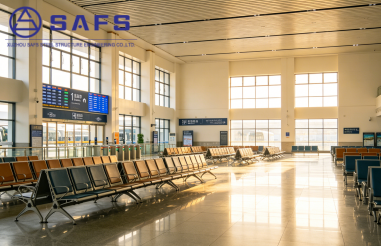
With craftsmanship-driven construction and integrity-driven win-win cooperation, SAFS Steel Structure sincerely looks forward to joining hands with Egyptian local construction partners. Leveraging the industrial advantages of Xuzhou—the “Capital of Space Frames in China”—alongside mature engineering expertise and high-quality structural solutions, we aim to jointly build beautiful, durable, modern waiting halls and contribute Chinese steel structure strength to Egypt’s transport infrastructure renaissance.