Dapeng Town Industrial Park, Tongshan District, Xuzhou City, Jiangsu Province, China
Mining companies establishing large-span ore storage sheds in Tanzania‘s Mwanza region have long faced persistent site adaptation challenges. Local ore stockyards must accommodate heavy loading equipment and large-scale ore stockpiling. Operating under the unique conditions of a lake district inland site, three critical issues—wind load erosion, mining-site corrosion, and the balance between span and column placement—directly impact the safety and service life of storage sheds as well as mining operational efficiency, ultimately affecting ongoing maintenance and remediation costs.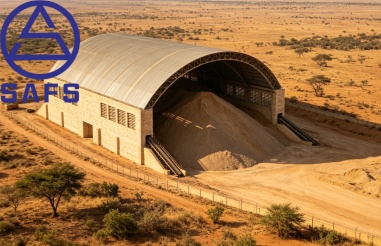 Tanzania’s mining sector is experiencing unprecedented growth. The country ranked 4th in Africa for mining investment attractiveness in the Fraser Institute‘s 2025 Annual Survey of Mining Companies. The $523 million Nyanzaga Gold Mine project in Sengerema, Mwanza, is currently under full-scale construction and expected to begin production in the first quarter of 2027. Mineral reserves at the project increased significantly to 4.0 million ounces as of February 2026, up from 2.3 million ounces previously—a 73% increase. The mine is expected to produce an average of 200,000 ounces of gold annually over a 16-year mine life. Over 3,000 employees and contractors are currently engaged at the site, with 97% being Tanzanians. The Tanzanian government has also prioritized industrial growth and railway expansion in the 2026/27 budget, including the Standard Gauge Railway connecting Dodoma to Mwanza. This mining boom drives sustained demand for durable, well-adapted ore storage infrastructure in the Mwanza region.
Mwanza sits adjacent to Lake Victoria—Africa‘s largest lake. Air currents sweeping across the lake frequently produce sudden day-night gusts with variable directions and strong impact forces. Conventional mining shed roofs have large wind-facing surface areas, and simple truss structures lack wind-pressure optimization design. Strong winds can easily lift cladding panels, strain steel frame joints, and cause component deformation and roof leakage. Local conventional steel structure designs only account for standard wind speeds and cannot handle the sudden lake-area gusts. Insufficient wind load redundancy in storage sheds creates prominent operational safety hazards.
Mining operations generate fine dust carrying trace acidic or alkaline mineral media. Combined with the region‘s year-round high humidity and day-night condensation moisture, dust adhering to steel surfaces forms corrosive agents when exposed to moisture, continuously eroding steel members and roof cladding. Standard anti-corrosion steel structures show paint peeling, section rusting, and panel perforation within just a few years. Mining dust is difficult to clean, and corners and splice joints corrode even faster. Frequent anti-corrosion recoating continuously consumes mine production funds and construction timelines.
The core requirement for mining storage sheds is column-free open space, facilitating truck and loader movement across the entire yard while minimizing column obstructions to operational flow. However, simply increasing single-span length raises steel frame load stress. Adding more columns reduces storage space and obstructs large equipment access. Most local design approaches fall to extremes—either column-dense layouts that waste valuable yard space, or oversized single-span frames with insufficient steel section that compromise structural stability. Neither approach successfully balances space utilization with structural safety.
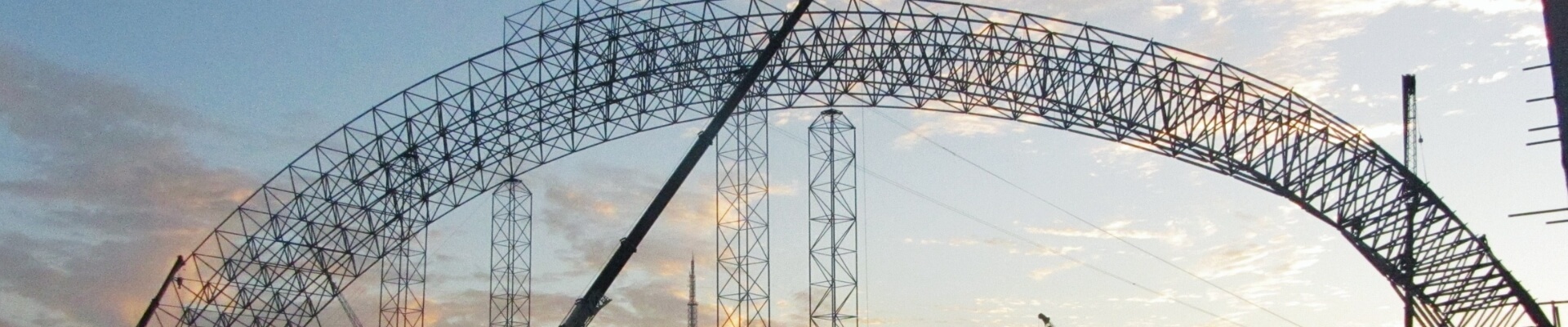
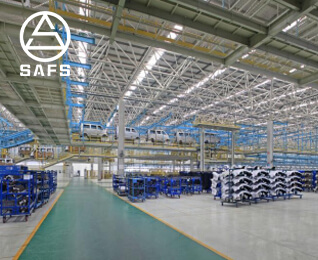
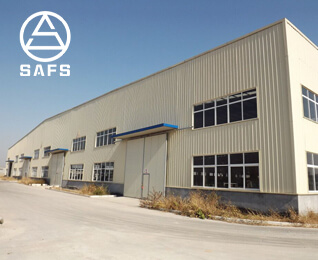
SAFS has been deeply involved in East African lake-district mining steel structure projects for years and is intimately familiar with Mwanza‘s lake-area wind patterns and mining-zone corrosion parameters. We focus on structural deepening, factory prefabrication, roof cladding, and on-site assembly technical services. Leveraging specialized mining-project design experience, we pragmatically solve the three critical issues of unstable wind loads, corrosion loss, and span-column imbalance—without exaggerating structural performance. Our solutions align with mining budgets and operational requirements, delivering durable, well-adapted, and maintenance-efficient standardized ore storage sheds.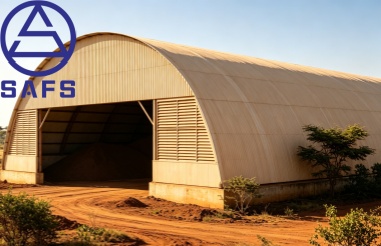 As a specialist in large-span steel space frames and pipe truss structures, SAFS offers:
Wind-load optimized designs tailored to Lake Victoria‘s unique gust patterns
Heavy-duty corrosion protection systems engineered for mining-zone composite corrosive environments
Large-span column-free solutions achieving spans of up to 100 meters to maximize operational space
Factory prefabrication with over 90% completion, accelerating on-site assembly by 60% compared to traditional methods
Cost-effective solutions with entry pricing from $30 to $80 per square meter
For mining operators, EPC contractors, and project developers in Tanzania‘s Lake Victoria goldfields, SAFS delivers the structural reliability and operational efficiency that mining projects demand.
Contact SAFS Steel Structure Engineering Co., Ltd.
Specializing in steel structure engineering, pipe truss engineering, space frame engineering, welded ball space frames, trestle engineering, and related fields.
Official website: https://www.safsteelstructure.com