Dapeng Town Industrial Park, Tongshan District, Xuzhou City, Jiangsu Province, China
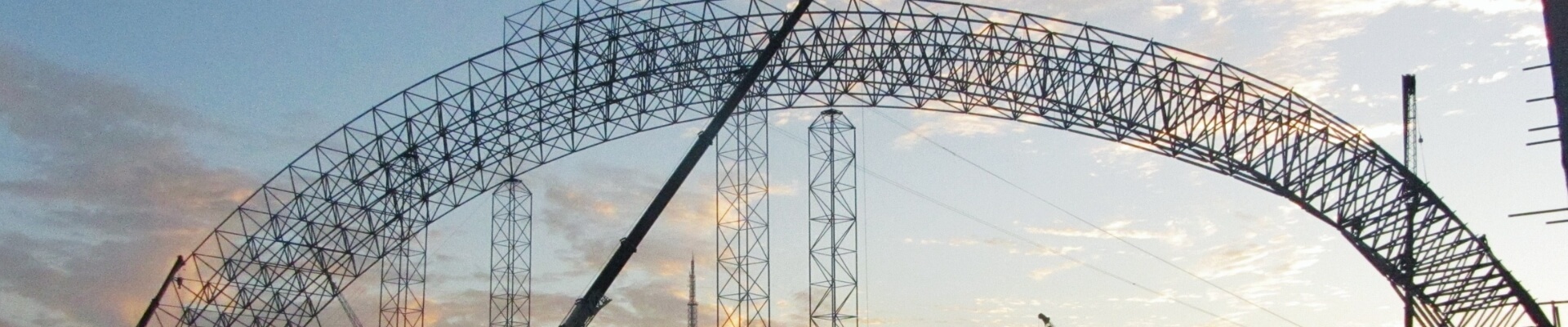
Steel space frames are widely used in long-span roofing systems. By arranging members and nodes in three dimensions, traditional planar forces are transformed into spatial collaboration, achieving remarkable mechanical efficiency: “doing more with less.” Compared to concrete structures, steel space frames reduce dead weight by more than 60% while eliminating internal columns to achieve spans exceeding 100 meters, freeing up vast, unobstructed interior spaces. Moreover, the grid texture of the space frame carries the aesthetic DNA of modern industry. Whether on the dome of a sports arena or the undulating roof of an airport, space frames deliver a light, transparent visual tension, perfectly aligning with the contemporary architectural pursuit of “technology as decoration.”
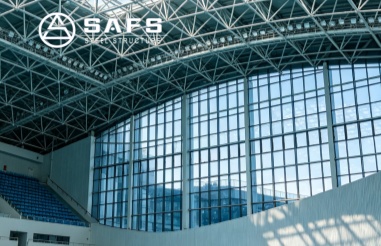
The steel space frame industry is entering a new era driven by green building and intelligent construction. In 2025, the First Prize of the China Steel Structure Science and Technology Award was granted to the “Key Technology for the Construction of Ultra-High, Long-Span Spatial Grid Structure Industrial Buildings,” which eliminates intermediate support columns and creates factory buildings with spans exceeding 140 meters and heights surpassing 110 meters, dramatically improving space utilization and layout flexibility. High-strength steels like Q690/Q890 are replacing conventional materials, reducing weight by 15%-25% while maintaining strength. The penetration rate of prefabricated steel structures continues to rise, with assembly rates reaching up to 95% in some projects, delivering significant life-cycle carbon reduction benefits. China’s large-span space frame market generated RMB 21.5 billion in sales revenue in 2024, and the global space frame system market is projected to reach USD 9.62 billion by 2031.
The steel space frame is a statically indeterminate spatial structure in which members primarily bear axial loads, enabling high material efficiency. Modern design leverages 3D3S, STAAD.Pro, and other finite element software for precise analysis of stress distribution and buckling modes under wind, snow, and seismic loads. BIM workflow coverage has surged from 47% in 2019 to 81% in 2023, while the adoption of intelligent welding robots has reached 68%, shortening project construction cycles by an average of 22%. Steel’s inherent ductility also enables significant seismic energy absorption. Economically, when spans exceed 30 meters, steel space frames offer superior cost-effectiveness compared to alternative structural systems.
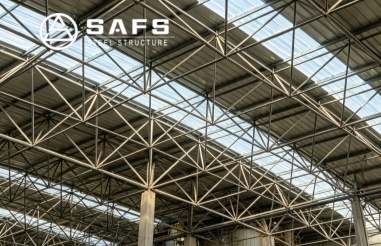
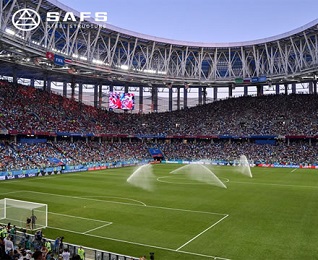
Case studies demonstrate the exceptional capability of steel space frames. Shenzhen Bay Sports Center (the “Spring Cocoon”) combines single-layer reticulated shells with double-layer curved space frames across a 532.7-meter roof. Beijing Daxing International Airport employs a space truss system achieving spans up to 150 meters. In recent breakthrough projects, the Hong Kong Kai Tak Sports Park Main Stadium, a large-span tubular truss structure with a maximum span of 181.8 meters, opened in early 2025 as the main venue for the 15th National Games. The Hangzhou Xiaoshan International Airport Phase III project adopted a large-span welded ball space frame and truss combination weighing over 100,000 metric tons, setting a new record for single-lift airport terminal roof construction in China. The Quanzhou Performing Arts Theatre features a quadrangular pyramid space frame with an 80-meter span and a 22-meter cantilever, woven from 24,200 members. Historic landmarks such as the Fuller Dome at the 1967 Montreal Expo and the Yas Viceroy Hotel in Abu Dhabi continue to inspire.
Looking ahead, steel space frames are evolving from single-function structures into multi-functional integrated systems, incorporating photovoltaics, intelligent monitoring sensors, and other advanced functions, moving toward unified “structure-energy-O&M” platforms. Meanwhile, high-end lightweight structural systems such as aluminum alloy reticulated shells are gaining momentum, offering exceptional lightweight performance and reduced maintenance demands. With the acceleration of carbon neutrality goals worldwide, steel structures are enjoying a golden era of development, driven by their recyclability, low emissions, and green building credentials.
The steel space frame—the spatial skeleton of long-span architecture—continues to deliver excellence in structural performance, sustainability, and design versatility. It awaits collaboration with architects and engineers who share a vision for creating spaces that inspire.