Dapeng Town Industrial Park, Tongshan District, Xuzhou City, Jiangsu Province, China
As the monumental economic restructuring of Saudi Arabia marches into Phase 3 of Vision 2030, the country‘s industrial infrastructure is undergoing an unprecedented wave of scaled-up modernization. In 2026, the third phase of Vision 2030 has transitioned from planning to execution and delivery — with the Kingdom’s sovereign wealth fund officially launching its new five-year strategy for 2026‑2030, moving national development from a broad “petrodollar splurge” toward a more mature stage focused on sustainability and private‑sector contributions. Economic diversification beyond oil has become the defining priority. The Saudi government has unveiled a sweeping industrial investment initiative worth a staggering US$427 billion, designed to attract large‑scale private capital over a decade‑long industrial development roadmap. Amid this historic national expansion of industrial capacity, the demand for supportive facilities — most notably industrial canopies for yards, loading bays, access roads and production halls — has evolved into an undisputed market necessity.
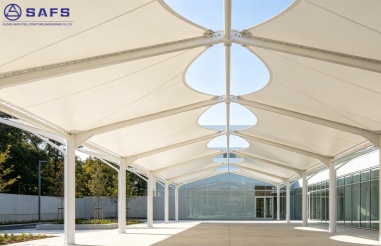
Yet, under the backdrop of Saudi Arabia’s harsh natural environment and a rapidly changing construction ecosystem, countless overseas investors have encountered persistent setbacks in the implementation of what appear to be simple canopy structures. From environmental degradation and structural failure to schedule overruns and non‑compliance, these seemingly low‑profile industrial shelters have become a systemic risk hotbed.
The vast desert interiors of Saudi Arabia are subjected to year‑round sandstorm attacks. High‑velocity winds carrying abrasive particles constantly bombard canopy cladding and critical joint zones, rapidly wearing down protective coatings and exposing structural steel to extreme corrosive environments. Even more perilous, drifting sand accumulates on canopy roofs, adding heavy sustained loads. Many low‑cost canopies that are not optimized for desert climates have seriously underestimated the weight of sand accumulation, frequently leading to roof sagging and component bending. In coastal industrial areas such as Dammam and Jubail, apart from sandstorms, high‑humidity salt‑laden air compounds the corrosion challenge with “salt‑spray corrosion,” gradually invading steel from the most vulnerable weld points and bolted connections, sending life‑cycle maintenance costs soaring.
Saudi Arabia’s building codes already impose more stringent requirements for wind loads and corrosion classes than most other international markets. Even widely used single‑span industrial canopies will exhibit “hidden damage” within a few years of operation if they lack a comprehensive whole‑life corrosion protection strategy and realistic sand‑load calculations.
Most conventional steel industrial canopies are designed with long‑span, column‑free interiors to accommodate heavy vehicle movement and material storage inside factories and warehouses. But what appears on the surface as a simple open space imposes significant technical demands on structural stability. The frequent, powerful sandstorm winds in Saudi Arabia are nearly “natural enemies” to lightly framed steel structures. Many hastily erected canopies using rudimentary fabrication techniques quickly develop frame loosening and overall drift under the persistent lateral oscillations of sandstorm‑force winds, resulting in visible structural deformation.
This is not only a safety hazard (once a steel canopy fails, it poses severe risks to on‑site equipment and personnel during high‑intensity sandstorms), but also a latent compliance hurdle — Saudi Arabia’s local building compliance reviews enforce demanding standards for structural design against wind forces and seismic risks. A large number of canopies built with conventional methods simply cannot pass formal approval, directly leading to project halts and costly redesign, with capital flows stretched indefinitely.
The practical challenges of on‑ground erection are often far more severe than paper designs suggest. The outdoor construction window during Saudi Arabia’s scorching summer months is extremely limited — during the most prohibitive months for field welding, daylight construction hours are severely compressed. Meanwhile, due to acute shortages of skilled steel‑structure workers, local recruitment costs are well above projected figures. Multiple industry reports earlier in 2026 have starkly noted that the skilled‑labor shortage in Saudi Arabia’s construction sector has evolved into a structural delivery risk, with no‑show positions becoming commonplace on many large‑scale projects. For traditional steel canopies, this drives significant labor cost inflation and increases the risk of in‑process quality flaws.
Moreover, traditional canopy construction relies heavily on on‑site welding and multiple rounds of in‑field fabrication, which demands high precision from on‑site craftsmen. If any localized weld fails to meet quality benchmarks in this high‑temperature saline environment, corrosion accelerates outward from that single weak point. Compounding this, fluctuating logistics cycles for building materials and frequent design‑change orders under Saudi project conditions make cost management a black hole for capital, with the eventual return on investment falling well below initial projections.
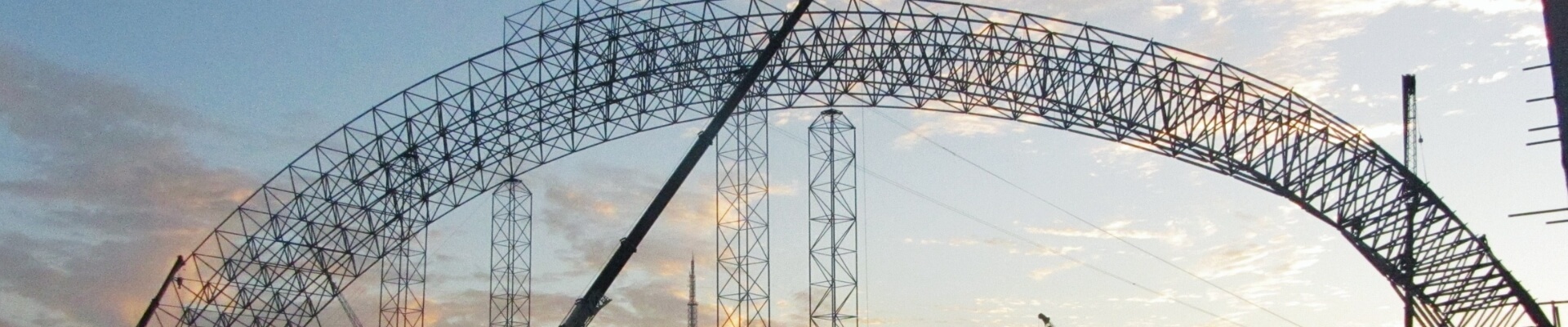
Facing the tightly stacked challenge of “environmental → structural → execution” constraints, SAFS Steel Structure has drawn on its long‑term on‑ground engagement with Saudi industrial facility delivery to precisely identify and deploy the mechanically robust SAFS space‑frame system as its primary technical offering. Every direction of technological upgrade follows the core logic of “adapting to local conditions with fit‑for‑purpose solutions.”
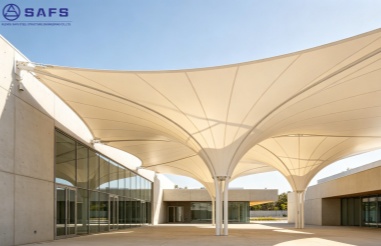
Based on its years of intensive engagement with Saudi Arabia’s industrial and mining enterprises, SAFS Steel Structure understands that the best building is not one that clings blindly to habitual construction methods, but one that precisely matches its environment. The SAFS space‑frame solution provides industrial canopies with a systematically reliable infrastructure that performs dependably across both desert and coastal conditions. With the unprecedented surge in industrial facility demand set to follow Vision 2030 beyond 2026, SAFS Steel Structure looks forward to partnering with more industrial enterprises committed to the Saudi market — designing the most cost‑effective, full‑life‑cycle optimal industrial canopy solutions based on each site’s unique regional environment and operational profile. We firmly believe: the true value of an industrial facility is not measured by its lowest first cost, but by its ability to support uninterrupted production rings — free from unplanned downtime — throughout a long operational life. Choosing SAFS Steel Structure means planting a clear safety and production‑upkeep baseline for your assets inside the desert and salt‑spray zones of Saudi Arabia.