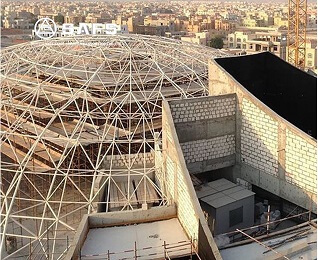
Dapeng Town Industrial Park, Tongshan District, Xuzhou City, Jiangsu Province, China
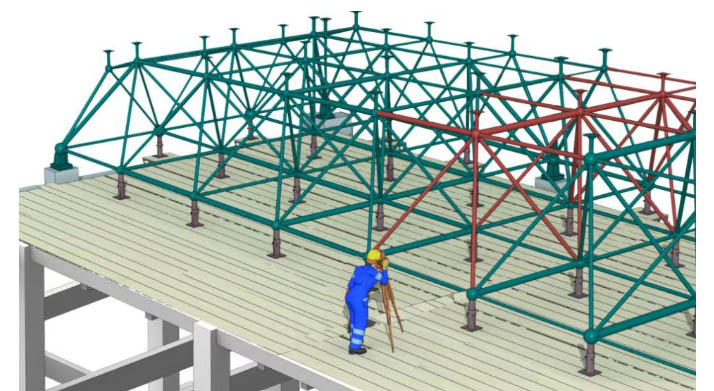
1. High-altitude assembly method
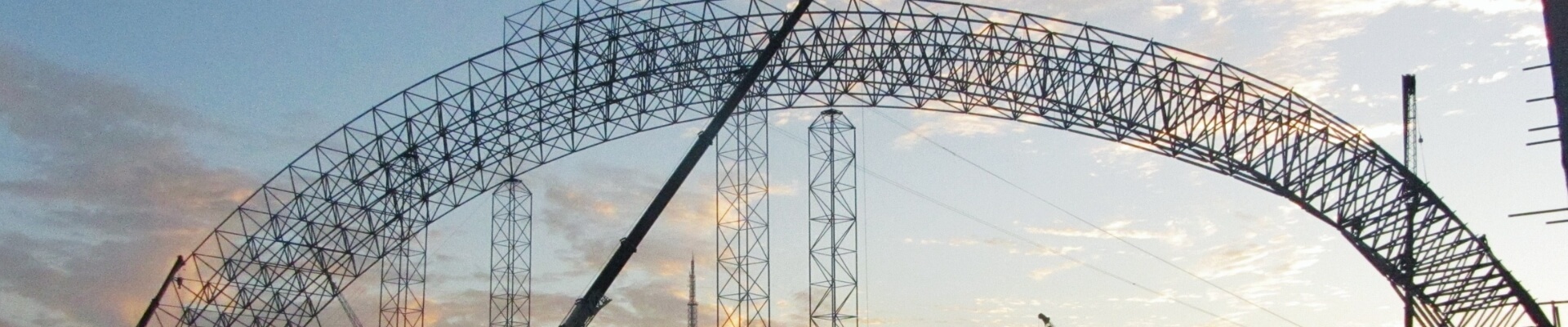
The method of assembling members and joints (or small sub-assemblies) directly into a complete structure at their designed positions at height is known as high-altitude assembly. This typically involves erecting full-area scaffolding (or full-area support structures) at the base of the structure, which is then used as a support to complete the assembly of the structural components in situ at height.
Characteristics: The structure is assembled in a single operation at the design elevation; this method is suitable for structures where neither the height nor the span is particularly large and the number of members is relatively small.
Advantages: Assembly can be completed using simple lifting and transport equipment, or even without lifting equipment at all, making it suitable for regions such as mountainous areas where lifting capacity is limited or transport is difficult. It facilitates precise control of joint coordinates, offers flexible construction, and allows for high reusability of scaffolding.
Disadvantages: It involves a significant amount of on-site and aerial work, requires a large quantity of scaffolding materials, results in a longer construction period, and occupies a considerable amount of site space.
2. Strip or Block Installation Method
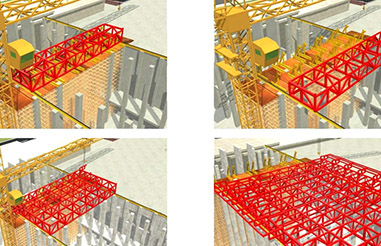
The structure is divided into a number of strip-shaped or block-shaped units. Each strip (or block) unit is assembled on the ground before being hoisted by a crane to its designated position and joined together to form a complete structure. This method is known as the strip (or block) hoisting method.
Construction sequence: First, the structure is divided into appropriate construction sections, and the structure within each section is subdivided into lifting units. Components and joints are assembled into lifting units on the ground; then, depending on the sectioning, a construction support system is installed at the section joints; subsequently, lifting equipment is used to hoist the lifting units onto the construction support system, and additional members are installed; finally, once the structure forms a complete structural system, the load is removed, bringing the structure to its designed state.
Characteristics: As the strip (or block) units are assembled on the ground, the volume of work at height is significantly reduced compared to the conventional method of assembling components in the air. This results in high construction efficiency and easier quality control. The number of assembly scaffolds is also greatly reduced, whilst existing lifting equipment can be fully utilised, making it a relatively economical approach. Applicability: Steel roof structures where the stiffness and stress conditions of the structure change only slightly after division.
3. Sliding Method
The sliding method is typically employed when the site conditions are unsuitable for the movement of lifting equipment, the installation location is difficult to access by lifting, or the equipment required for conventional lifting methods is too large. The sliding method is an installation technique that utilises synchronously controlled traction or thrusting equipment to move a structure—divided into several stable construction sections—along a set track from the assembly position to the design position. Classification of high-altitude sliding methods based on the sliding entity:
a. Structural sliding
b. Construction support sliding
Classification of structural sliding methods:
a. Single-section sliding method
b. Cumulative sliding method
a. Single-section sliding method: Strip-shaped units are slid one by one from one end to the other for positioning and installation, with each unit subsequently connected at height. That is, sliding one section at a time and connecting them sequentially to form a whole.
b. Cumulative sliding method: First, slide a strip-shaped unit a certain distance (sufficient to connect to the second unit), then connect the second unit; slide both units together a further distance (of the same width), then connect the third unit; slide all three units together a further distance, and so on in a cyclical process until the final unit is connected.
The single-unit sliding method requires less sliding force but necessitates supplementary installation at height in stages, and places higher demands on the rigidity of the sliding section; whereas the cumulative sliding method requires progressively increasing sliding force, but as the structure is assembled into a whole in stages, its rigidity increasingly approaches the design state, and there is no need to leave the working platform to install members at height. From the perspectives of construction duration and safety, the cumulative sliding method offers certain advantages and is therefore more widely adopted.
4. Integral Lifting Method
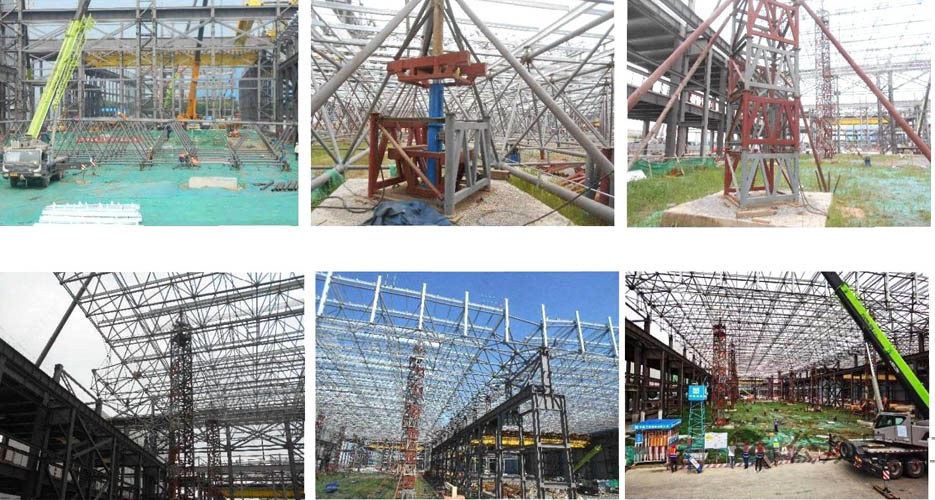
An installation method whereby the structure is assembled and positioned on the ground before being lifted or jacked vertically by lifting equipment to the design elevation.
Lifting Construction Techniques: An installation process in which components and joints are assembled on the ground or at a suitable location, and the structure is then lifted to its design position using multiple lifting machines. Depending on the components being lifted, this can be categorised into integral lifting, unit lifting, cumulative lifting, and so on. Currently, lifting machinery predominantly utilises computer-controlled hydraulic hoists; however, for smaller-scale projects or where conditions are unsuitable, traditional equipment such as chain hoists and winch units may also be employed.
Jacking Construction Technique: This refers to a construction method whereby, after the structure has been assembled as a whole, jacking equipment (hydraulic jacks) and jacking frames are used to gradually raise the structure to the design elevation. Compared to lifting techniques, jacking operations are carried out at ground level, eliminating the need to establish working points at height and thereby reducing the need for lifting supports and other measures. However, jacking operations require the coordinated use of support frames and jacking frames; when the structure is excessively tall or there are too many jacking points, the quantity of jacking frames required increases significantly, resulting in poor cost-effectiveness.
 5. Integral Lifting Method
The integral lifting method refers to the process of assembling a structure into a single unit on the ground and then using lifting equipment to hoist it into its designated position.
Characteristics of the integrated lifting method: Assembly is carried out either on-site with the columns offset or off-site. The structure is lifted to a high elevation using a derrick or multiple cranes, and then rotated or translated into its design position. The advantage of on-site assembly is that it facilitates the assurance of welding quality and the accuracy of geometric dimensions; the disadvantage is that it requires substantial lifting capacity and the use of super-heavy-duty lifting equipment for direct hoisting.