
Dapeng Town Industrial Park, Tongshan District, Xuzhou City, Jiangsu Province, China
As Africa‘s food processing industry accelerates its industrialization, sectors including fruit and vegetable processing, grain refining, snack foods, and prepared ingredients are expanding rapidly. Countries across the continent are implementing stringent food safety standards—HACCP, ISO 22000, and local certifications such as Kenya’s KEBS—which impose mandatory requirements on factory cleanliness, zoning compliance, sanitation protocols, and ventilation systems. Traditional brick-and-mortar factory buildings, with their crack-prone walls, moisture-retaining floors, and rigid layouts, create numerous hygiene blind spots that make it difficult to pass official food safety inspections—posing a significant barrier to scaling production for African food enterprises. SAFS Steel Structure, aligned with African food processing compliance standards and local operating conditions, delivers custom food-grade steel structure factory solutions that support the standardized upgrading of the region‘s food industry.
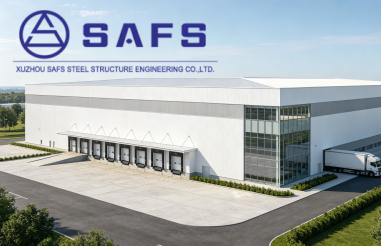
Africa’s food processing industry is in a phase of rapid expansion and profound transformation, maintaining an average annual growth rate of approximately 5.8% over the past five years. The market was valued at over $180 billion in 2023 and is projected to surpass $220 billion by 2026. The African Development Bank projects the broader food and agribusiness sector could reach $1 trillion by 2030. Yet Africa still imports approximately $65 billion of processed food annually—highlighting a major value-addition gap and immense opportunity for local processing capacity expansion.
Major investments are already underway. In Uganda, the $200–248 million Nonda Coffee Park is scheduled to break ground in October 2026. Nigeria‘s President commissioned Bensono’s 40,000-metric-tonne-per-day fruit concentrate plant in Benue. Barry Callebaut is building a $30 million chocolate factory in North Africa. Sujimoto Group has launched a multi-million dollar food manufacturing operation. Norfund has invested $15 million in an aseptic packaging facility in Kenya. With an estimated 15–25 new dairy, poultry, and ready-to-eat processing plants expected to be built annually across East and West Africa through 2030, the demand for compliant, hygienic, and scalable factory infrastructure has never been greater.
Modern food processing strictly requires physical separation of raw material receiving, primary processing, refined production, packaging, and finished goods storage areas to prevent cross-contamination. SAFS‘s modular steel structure system enables flexible functional zone planning, paired with food-grade smooth cladding panels that feature seamless, dead-corner-free surfaces—resistant to dust accumulation and mold growth. These surfaces withstand high-frequency washing and sanitization procedures, fully satisfying local certification requirements including Kenya’s KEBS standards, Ghana‘s food regulatory framework, and Tanzanian FDA food specifications. This ensures enterprises pass compliance inspections smoothly and maintain certification over the long term.
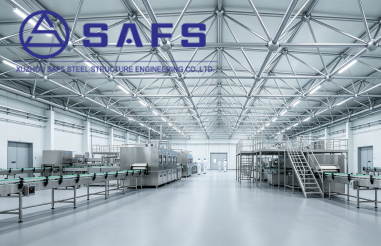
Most African regions experience high temperatures, humidity, and poor natural air circulation. Food processing generates steam, lampblack, and residual odors that, if detained, can accelerate spoilage and attract pests. SAFS leverages steel structures’ inherent adaptability to customize systematic ventilation, air exchange, and negative-pressure exhaust systems that rapidly remove heat, moisture, and production odors. Integrated drainage and waste flow channels efficiently handle production wastewater and by-products, maintaining a consistently clean and dry working environment that meets food safety requirements.
Power supply instability in parts of Africa means food processing equipment experiences frequent start-stop cycles, placing higher demands on structural stability and equipment mounting safety. SAFS steel structures offer high overall rigidity and uniform load distribution, capable of securely supporting the entire set of processing equipment—including refrigeration, drying, sterilization, and conveying systems—under both intermittent and continuous operation. The large-span open layout provides flexibility for backup equipment and utility routing, ensuring stable production adapted to local energy conditions.
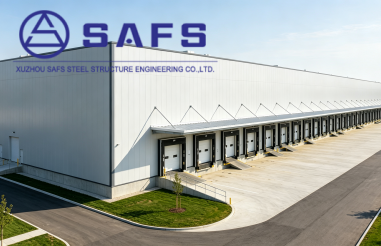
African food enterprises are seizing opportunities in import substitution and export markets, requiring rapid factory construction and upgrades. SAFS‘s factory-prefabricated, on-site rapid assembly construction model delivers short project timelines, clean worksites with no construction waste, and minimal disruption to existing operations—aligning perfectly with the food industry’s green production requirements. Deeply engage in Africa‘s food infrastructure sector, SAFS delivers steel structure solutions that are compliant, climate-adapted, durable, and rapidly deployable—comprehensively empowering the standardized, high-quality, and sustainable development of Africa’s food processing industry.
Contact Xuzhou SAFS Steel Structure Engineering Co., Ltd. (SAFS)
Specializing in steel structure engineering, pipe truss engineering, space frame engineering, welded ball space frames, trestle engineering, and related fields.