Dapeng Town Industrial Park, Tongshan District, Xuzhou City, Jiangsu Province, China
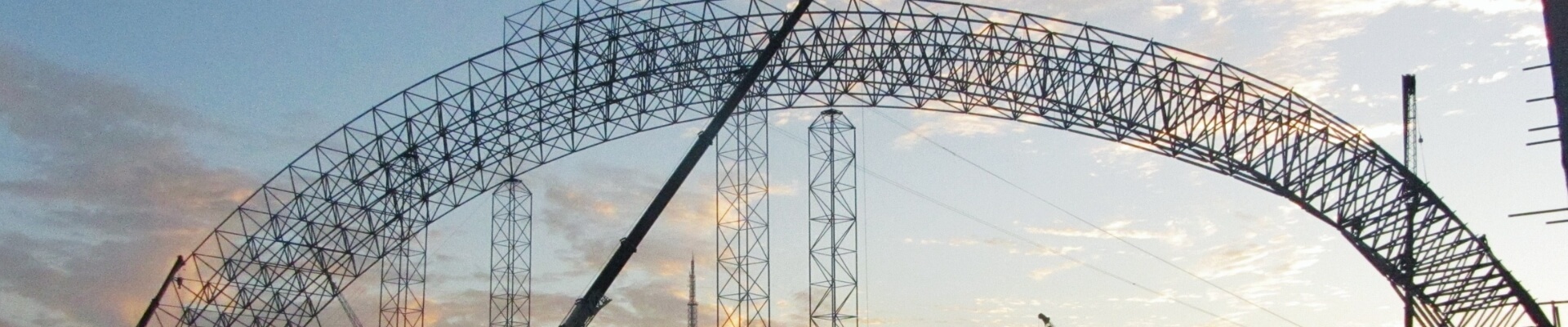
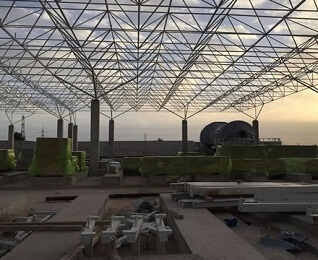
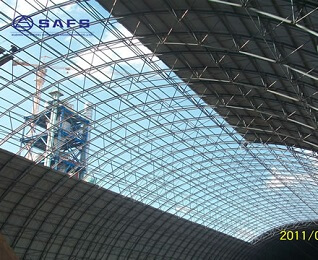
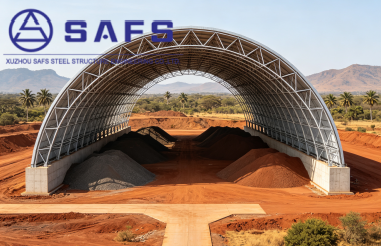
Mining companies investing in material storage sheds across Ethiopia‘s mining regions face persistent challenges in delivering industrial-grade steel structures. Ore storage sheds require long-term outdoor operation with large-span open spaces for material stockpiling, loading, and transfer—demanding stringent standards in structural stability, material quality, and construction craftsmanship. Three overlapping constraints—local steel supply gaps, harsh open-field wind conditions, and a shortage of specialized construction expertise—frequently cause project delays, structural vulnerabilities, and costly ongoing maintenance, directly impacting the efficiency of routine mining site material handling.
Bottleneck 1: Severe Local Steel Supply Shortages
Ethiopia‘s domestic steel production capacity falls critically short, making it the primary obstacle to mining project execution. While demand for construction-grade steel continues to rise, local steel mills are constrained by foreign currency shortages and raw material import bottlenecks. Capacity utilization often remains below 20–30% due to these raw material shortages. Industrial-grade profiles, large-span components, and heavy-duty cladding materials are extremely limited—local production can only supply basic civil construction materials, leaving mining-specific steel products with extremely low self-sufficiency rates.
The shortage is compounded by severe logistics bottlenecks. As industrial output expands, manufacturers face increasing delays in raw material imports, with ships queuing at ports and disrupting production schedules. The Ethiopian Construction Works Corporation (ECWC) has drawn industry criticism for importing thousands of tons of metal products while purchasing only minimal quantities locally—highlighting the systemic gap in domestic supply. Many manufacturers are being forced to close shops due to lack of access and shortage of foreign currency to import raw materials.
Bottleneck 2: Strong Wind Conditions in Open Mining Areas
While material supply is unstable, the strong wind conditions across Ethiopia‘s open plateau mining areas continuously test storage shed structural stability. Most mining sites are located in exposed highland areas with no natural windbreaks, subject to seasonal gusts and sustained crosswinds. With large spans and extensive roof areas, standard light steel structures lack sufficient stiffness and joint reinforcement, providing inadequate wind load redundancy.
Under repeated wind loading, components deform, roof panels loosen, and sealing joints tear—compromising not only dust containment but also creating structural safety hazards. The Ethiopian Building Code Standard for Loading requires accurate calculation of basic wind pressure, yet many local designs fail to meet these specifications. In some highland areas, design wind speeds reach 22m/s (79.2km/h) , demanding specialized engineering that many local fabricators cannot provide.
Bottleneck 3: Insufficient Local Construction Expertise
Beyond hardware constraints, the lack of local specialized construction experience further amplifies quality risks. Local construction teams have long focused on ordinary civil building projects, lacking hands-on experience with mining-site large-span steel structures, wind-load-specific reinforcement, and industrial-grade cladding sealing. Their understanding of field construction techniques and component assembly mechanics remains limited.
On-site assembly precision is poor, joint fastening is not in compliance with standards, and roof finishing is rough—resulting in deformation, leakage, and substandard wind resistance after completion. The resulting rectification costs are high and severely disrupt normal mining operations. The technical skills gap in steel manufacturing and construction has been repeatedly cited as a key constraint.
Ethiopia’s mining sector is transitioning from artisanal to large-scale industrial development. Gold has recently overtaken coffee as the nation’s top export earner, generating approximately USD 3.5 billion in the 2024/25 fiscal year. The country sits atop the Arabian-Nubian Shield, hosting some of the world’s most significant deposits of gold, copper, and base metals.
In early 2026, a definitive pivot is underway. Major developments include:
Zijin Mining Group acquired Allied Gold for approximately USD 4 billion in January 2026, with the Kurmuk Gold Project in western Ethiopia—backed by USD 620 million investment—poised to become the country‘s largest modern industrial gold mine.
KEFI Gold and Copper awarded a USD 400 million mining services contract to BCM Group for the Tulu Kapi Gold Project in June 2026, with first gold pour targeted for mid-2026.
Rashmi Group signed a USD 300 million MoU for gold exploration and mineral processing facilities during the Invest in Ethiopia – High-Level Business Forum 2026.
Ethiopian Investment Holdings, with assets exceeding USD 45 billion, secured a 365-square-kilometer potash concession in the Danakil Depression, partnering with Dangote Group on a USD 2 billion+ urea fertilizer complex.
These projects are driving unprecedented demand for durable, large-span steel storage infrastructure. But without reliable steel supply and specialized construction capability, project timelines and structural integrity remain at serious risk.
Addressing the multiple pain points of Ethiopian mining site storage shed construction, SAFS Steel Structure provides precision-matched industrial solutions. Leveraging a mature industrialized prefabrication system, we supply mining-specific steel and cladding materials in one integrated package—completely bypassing local production gaps and supply instability. Using site-measured wind load data, we optimize primary and secondary structural bracing layouts and roof fixing systems to enhance overall wind resistance for open-field conditions. Drawing on extensive overseas mining construction experience, we deploy standardized assembly processes and refined workmanship to fill local technical gaps and ensure project precision and quality.
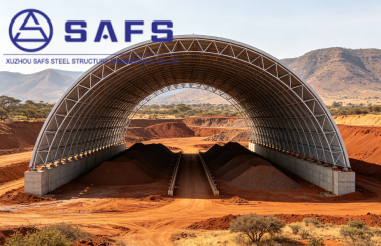
With years of deep engagement in Ethiopia‘s industrial and mining steel structure sector, SAFS is intimately familiar with local steel market realities, highland wind characteristics, and mining construction standards. We focus on the refined execution of structural, roofing, and cladding systems—delivering prefabrication-driven efficiency, site-condition-adapted structural design, and standardized precision craftsmanship to solve material shortages, wind load instability, and construction precision shortfalls. We help mining operators build durable, schedule-reliable, maintenance-efficient professional material storage sheds adapted to round-the-clock mining operations.
Contact SAFS Steel Structure Engineering Co., Ltd. (SAFS)
Specializing in steel structure engineering, pipe truss engineering, space frame engineering, welded ball space frames, trestle engineering, and related fields.